
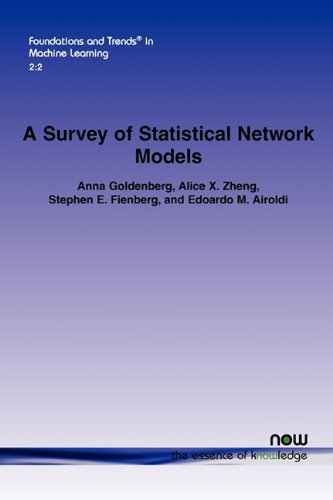
A Survey of Statistical Network Models
by A. Goldenberg, A.X. Zheng, S.E. Fienberg, E.M. Airoldi
Publisher: arXiv 2009
ISBN/ASIN: 1601983204
ISBN-13: 9781601983206
Number of pages: 96
Description:
We begin with an overview of the historical development of statistical network modeling and then we introduce a number of examples that have been studied in the network literature. Our subsequent discussion focuses on a number of prominent static and dynamic network models and their interconnections. We emphasize formal model descriptions, and pay special attention to the interpretation of parameters and their estimation.
Download or read it online for free here:
Download link
(1.7MB, PDF)
Similar books
 Boosting: Foundations and Algorithms
by Robert E. Schapire, Yoav Freund - The MIT Press
Boosting is an approach to machine learning based on the idea of creating a highly accurate predictor by combining many weak and inaccurate 'rules of thumb'. A remarkably rich theory has evolved around boosting, with connections to a range of topics.
(6481 views)
 The Hundred-Page Machine Learning Book
by Andriy Burkov
This is the first successful attempt to write an easy to read book on machine learning that isn't afraid of using math. It's also the first attempt to squeeze a wide range of machine learning topics in a systematic way and without loss in quality.
(8719 views)
 Introduction To Machine Learning
by Nils J Nilsson
This book concentrates on the important ideas in machine learning, to give the reader sufficient preparation to make the extensive literature on machine learning accessible. The author surveys the important topics in machine learning circa 1996.
(29389 views)
 A Brief Introduction to Machine Learning for Engineers
by Osvaldo Simeone - arXiv.org
This monograph provides the starting point to the literature that every engineer new to machine learning needs. It offers a basic and compact reference that describes key ideas and principles in simple terms and within a unified treatment.
(6670 views)