
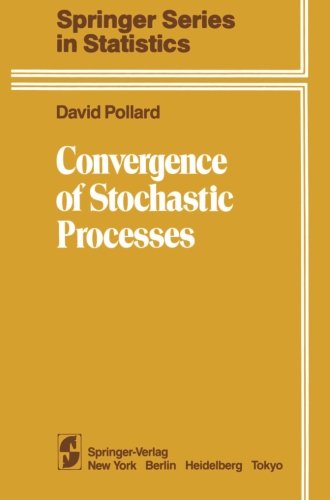
Convergence of Stochastic Processes
by D. Pollard
Publisher: Springer 1984
ISBN/ASIN: 1461297583
ISBN-13: 9781461297581
Number of pages: 223
Description:
An exposition od selected parts of empirical process theory, with related interesting facts about weak convergence, and applications to mathematical statistics. The high points of the book describe the combinatorial ideas needed to prove maximal inequalities for empirical processes indexed by classes of sets or classes of functions.
Download or read it online for free here:
Download link
(8.6MB, PDF)
Similar books
 Non-Uniform Random Variate Generation
by Luc Devroye - Springer
The book on small field on the crossroads of statistics, operations research and computer science. The applications of random number generators are wide and varied. The study of non-uniform random variates is precisely the subject area of the book.
(15188 views)
 Random Matrix Models and Their Applications
by Pavel Bleher, Alexander Its - Cambridge University Press
The book covers broad areas such as topologic and combinatorial aspects of random matrix theory; scaling limits, universalities and phase transitions in matrix models; universalities for random polynomials; and applications to integrable systems.
(16913 views)
 A Minimum of Stochastics for Scientists
by Noel Corngold - Caltech
The book introduces students to the ideas and attitudes that underlie the statistical modeling of physical, chemical, biological systems. The text contains material the author have tried to convey to an audience composed mostly of graduate students.
(12254 views)
 Applied Nonparametric Regression
by Wolfgang Härdle - Cambridge University Press
Nonparametric regression analysis has become central to economic theory. Hardle, by writing the first comprehensive and accessible book on the subject, contributed enormously to making nonparametric regression equally central to econometric practice.
(26908 views)