
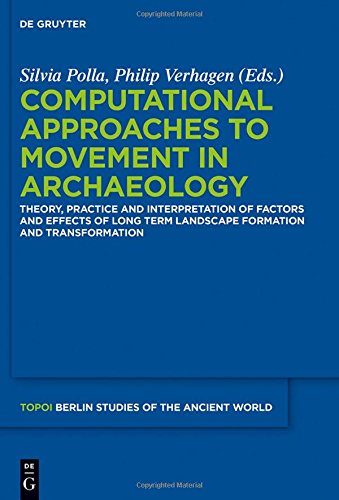
Computational Approaches to the Study of Movement in Archaeology
by Silvia Polla, Philip Verhagen
Publisher: De Gruyter Open Ltd 2014
ISBN/ASIN: 3110288311
Number of pages: 137
Description:
The archaeological study of movement and of its related patterns and features has been transformed by the use of GIS. Path analysis has become a very popular approach to the study of settlement and land-use dynamics in landscape archaeology. This volume addresses theoretical, technical and interpretative issues and presents case studies.
Download or read it online for free here:
Download link
(multiple PDF files)
Similar books
 An Archaeology of Greece
by Anthony M. Snodgrass - University of California Press
In this book, Anthony Snodgrass argues that classical archaeology has a rare potential in the whole field of the study of the past to make innovative discoveries and apply modern approaches by widening the aims of the discipline.
(11123 views)
 The Archaeology of Death in Post-medieval Europe
by Sarah Tarlow (ed.) - Walter de Gruyter & Co.
There is now a real appetite on the part of those researching the burial practices of the last 500 years for an opportunity to present our work. This volume represents an early contribution to a discussion of what is still a new area of research.
(5288 views)
 Landscape Archaeology between Art and Science
by Sjoerd J. Kluiving, Erika Guttmann-Bond (eds) - Amsterdam University Press
This volume is focusing on the definition of landscape as used by processual archaeologists, earth scientists, and most historical geographers. It provides a rich foundation for discussion, and the papers in this collection cover a variety of topics.
(5560 views)
 Mesopotamian Archaeology
by Percy S. P. Handcock - Macmillan & Co.
In addition to the chapters which deal expressly with the cultural evolution of the dwellers in Mesopotamia, two chapters are devoted to the Cuneiform writing -- its pictorial origin, the history of its decipherment, and the literature...
(8533 views)