
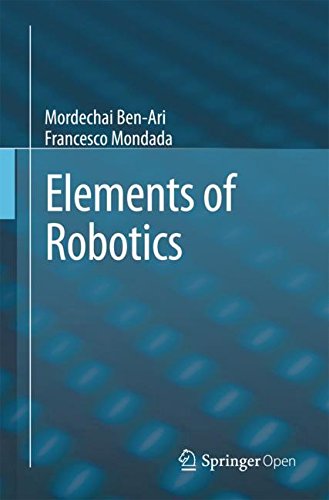
Elements of Robotics
by Mordechai Ben-Ari and Francesco Mondada
Publisher: Springer 2018
ISBN-13: 9783319625331
Number of pages: 308
Description:
This book bridges the gap between playing with robots in school and studying robotics at the upper undergraduate and graduate levels to prepare for careers in industry and research. Robotic algorithms are presented formally, but using only mathematics known by high-school and first-year college students, such as calculus, matrices and probability. Concepts and algorithms are explained through detailed diagrams and calculations.
Download or read it online for free here:
Download link
(multiple PDF files)
Download mirrors:
Mirror 1
Similar books
 Simulated Annealing
by Cher Ming Tan - IN-TECH
This book provides the readers with the knowledge of Simulated Annealing and its applications in the various branches of engineering. We encourage readers to explore the application of Simulated Annealing in their work for the task of optimization.
(15196 views)
 Distributed Control of Robotic Networks
by Francesco Bullo, Jorge Cortes, Sonia Martinez - Princeton University Press
This introductory book offers a distinctive blend of computer science and control theory. The book presents a broad set of tools for understanding coordination algorithms, determining their correctness, and assessing their complexity.
(12591 views)
 Introduction to Autonomous Robots
by Nikolaus Correl - Magellan Scientific
This book introduces concepts in mobile, autonomous robotics to students in Computer Science. The book covers principles of robot motion, forward and inverse kinematics of robotic arms and simple wheeled platforms, perception, error propagation, etc.
(6204 views)
 From Bricks to Brains: The Embodied Cognitive Science of LEGO
by M. Dawson, B. Dupuis, M. Wilson - AU Press
From Bricks to Brains introduces embodied cognitive science, and illustrates its foundational ideas through the construction and observation of LEGO Mindstorms robots. The book places a renewed emphasis on sensing and acting.
(8698 views)