
Mathematics of Relativity: Lecture Notes
by G. Y. Rainich
Publisher: Edwards Brothers 1932
Number of pages: 222
Description:
We may consider Geometry as a first attempt at a study of the outside world. It may be considered as a deductive system which reflects (in the sense explained above, that is of the existence of a correspondence, etc.) very well our experiences with some features of the outside world, namely features connected with the displacements of what we call rigid bodies. We see at once how much is left out in such a study; in the first place, time is almost entirely left out: in trying to bring into coincidence two triangles we are not interested in whether we move one slowly or rapidly; in describing a circle we are not concerned with uniformity of motion.
Download or read it online for free here:
Download link
(multiple formats)
Similar books
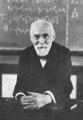 The Einstein Theory of Relativity
by Hendrik Antoon Lorentz - Feedbooks
There is a constant demand for information about this much-debated topic of relativity. In order to make a popular explanation of this far-reaching theory available, the present book is published. (first published in 1920)
(15267 views)
 An Introduction to the Theory of Relativity
by L. Bolton - E.P. Dutton & Co.
This little book gives a remarkably readable and intelligible account of the theory of relativity. The author is presenting his material without presupposing more than elementary algebra and the elements of plane geometry.
(10672 views)
 Relativity For Physics Students
by G. B. Jeffery - Methuen & Company
Contents: The origins of the theory; Michelson-Morley experiment and the Lorentz transformation; Laws of motion and electro-magnetism; Restricted principle of relativity and some consequences; Equivalence hypothesis; Four-dimensional continuum; etc.
(11890 views)
 Space: from Euclid to Einstein
by Roy McWeeny - Learning Development Institute
This book goes back to the work of the philosophers and astronomers of two thousand years ago; and it extends to that of Einstein, whose work laid the foundations for our present-day ideas about the nature of space itself.
(10420 views)