
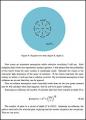
Three Lectures on Complexity and Black Holes
by Leonard Susskind
Publisher: arXiv.org 2018
Number of pages: 84
Description:
The first lecture describes the meaning of quantum complexity, the analogy between entropy and complexity, and the second law of complexity. Lecture two reviews the connection between the second law of complexity and the interior of black holes. The final lecture is about the thermodynamics of complexity, and 'uncomplexity' as a resource for doing computational work.
Download or read it online for free here:
Download link
(3.9MB, PDF)
Similar books
 Harmonic Oscillators and Two-by-two Matrices in Symmetry Problems in Physics
by Young Suh Kim (ed.) - MDPI AG
With a degree of exaggeration, modern physics is the physics of harmonic oscillators and two-by-two matrices. Indeed, they constitute the basic language for the symmetry problems in physics, and thus the main theme of this journal.
(6120 views)
 Physics, Topology, Logic and Computation: A Rosetta Stone
by John C. Baez, Mike Stay - arXiv
There is extensive network of analogies between physics, topology, logic and computation. In this paper we make these analogies precise using the concept of 'closed symmetric monoidal category'. We assume no prior knowledge of category theory.
(10983 views)
 Lectures on Nonlinear Waves And Shocks
by Cathleen S. Morawetz - Tata Institute Of Fundamental Research
Introduction to certain aspects of gas dynamics concentrating on some of the most important nonlinear problems, important not only from the engineering or computational point of view but also because they offer great mathematical challenges.
(9066 views)
 Foundations Of Potential Theory
by Oliver Dimon Kellog - Springer
The present volume gives a systematic treatment of potential functions. It has a purpose to serve as an introduction for students and to provide the reader with the fundamentals of the subject, so that he may proceed immediately to the applications.
(6963 views)