
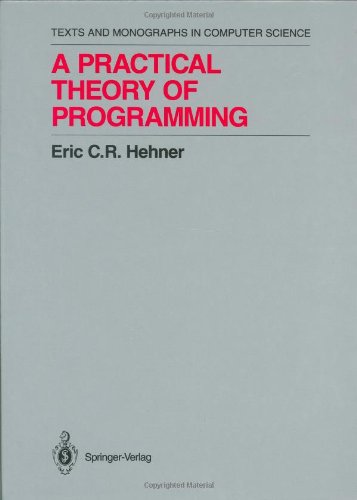
A Practical Theory of Programming
by Eric C.R. Hehner
Publisher: Springer 2006
ISBN/ASIN: 0387941061
ISBN-13: 9780387941066
Number of pages: 243
Description:
Understanding programming and programming languages requires knowledge of the underlying theoretical model. This book explores aspects of programming that are amenable to mathematical proof. The author describes a programming theory which is much simpler and more comprehensive than the current theories to date. In the theoretical model, a specification is just a boolean expression and refinement is just an ordinary implication. The author develops a practical and broad method for writing precise specifications and designing programs whose executions probably satisfy the specifications.
Download or read it online for free here:
Download link
(multiple PDF files)
Similar books
 Programming Languages: Application and Interpretation
by Shriram Krishnamurthi - Lulu.com
The textbook for a programming languages course, taken primarily by advanced undergraduate and beginning graduate students. This book assumes that students have modest mathematical maturity, and are familiar with the existence of the Halting Problem.
(12825 views)
 Exploring Programming Language Architecture in Perl
by Bill Hails
This book presents an informal and friendly introduction to some of the core ideas in modern computer science, using the programming language Perl as its vehicle. The book takes the form of a series of working interpreters for the language PScheme.
(16258 views)
 Formal Language Theory for Natural Language Processing
by Shuly Wintner - ESSLLI
This text is a mild introduction to Formal Language Theory for students with little or no background in formal systems. The motivation is Natural Language Processing, and the presentation is geared towards NLP applications, with extensive examples.
(10759 views)
 Implementing Functional Languages: a tutorial
by Simon Peyton Jones, David Lester - Prentice Hall
This book gives a practical approach to understanding implementations of non-strict functional languages using lazy graph reduction. It is intended to be a source of practical material, to help make functional-language implementations come alive.
(13499 views)