
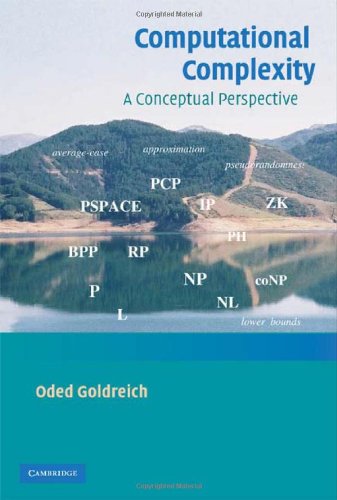
Computational Complexity: A Conceptual Perspective
by Oded Goldreich
Publisher: Cambridge University Press 2008
ISBN/ASIN: 052188473X
ISBN-13: 9780521884730
Number of pages: 632
Description:
This book offers a comprehensive perspective to modern topics in complexity theory, which is a central field of the theoretical foundations of computer science. It addresses the looming question of what can be achieved within a limited amount of time with or without other limited natural computational resources. The book can be used as an introduction for advanced undergraduate and graduate students as either a textbook or for self-study, or to experts, since it provides expositions of the various sub-areas of complexity theory such as hardness amplification, pseudorandomness and probabilistic proof systems.
Download or read it online for free here:
Download link
(1.4MB, PS)
Similar books
 Introduction to Complexity Theory
by Oded Goldreich
Complexity theory is the study of the intrinsic complexity of computational tasks. The book is aimed at exposing the students to the basic results and research directions in the field. The focus was on concepts, complex technical proofs were avoided.
(10670 views)
 Algorithmic Randomness and Complexity
by R. G. Downey, D. R. Hirschfeldt - Springer
Computability and complexity theory are two central areas of research in theoretical computer science. This book provides a systematic, technical development of algorithmic randomness and complexity for scientists from diverse fields.
(10042 views)
 Complexity Theory: A Modern Approach
by Sanjeev Arora, Boaz Barak - Cambridge University Press
The book provides an introduction to basic complexity classes, lower bounds on resources required to solve tasks on concrete models such as decision trees or circuits, derandomization and pseudorandomness, proof complexity, quantum computing, etc.
(17501 views)
 Mathematics and Computation
by Avi Wigderson - Princeton University Press
The book provides a broad, conceptual overview of computational complexity theory -- the mathematical study of efficient computation. It is useful for undergraduate and graduate students in mathematics, computer science, and related fields.
(3251 views)