
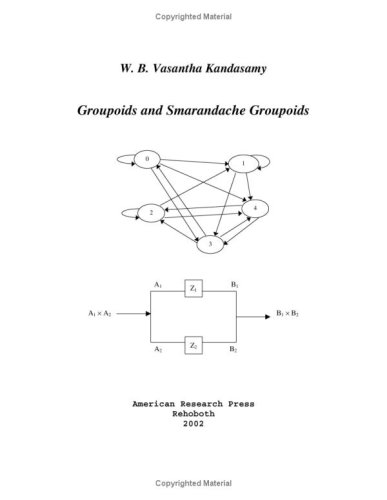
Groupoids and Smarandache Groupoids
by W. B. Vasantha Kandasamy
Publisher: American Research Press 2002
ISBN/ASIN: 1931233616
ISBN-13: 9781931233613
Number of pages: 115
Description:
This book aims to give a systematic development of the basic non-associative algebraic structures viz. Smarandache groupoids. Smarandache groupoids exhibits simultaneously the properties of a semigroup and a groupoid. Such a combined study of an associative and a non associative structure has not been so far carried out.
Download or read it online for free here:
Download link
(570KB, PDF)
Similar books
 Group Characters, Symmetric Functions, and the Hecke Algebra
by David M. Goldschmidt - American Mathematical Society
The book covers a set of interrelated topics, presenting a self-contained exposition of the algebra behind the Jones polynomial along with various excursions into related areas. Directed at graduate students and mathematicians.
(11950 views)
 Lectures on Semi-group Theory and its Application to Cauchy's Problem in Partial Differential Equations
by K. Yosida - Tata Institute of Fundamental Research
In these lectures, we shall be concerned with the differentiability and the representation of one-parameter semi-groups of bounded linear operators on a Banach space and their applications to the initial value problem for differential equations.
(12159 views)
 Group theory for Maths, Physics and Chemistry
by Arjeh Cohen, Rosane Ushirobira, Jan Draisma
Symmetry plays an important role in chemistry and physics. Group captures the symmetry in a very efficient manner. We focus on abstract group theory, deal with representations of groups, and deal with some applications in chemistry and physics.
(14331 views)
 Groups and Semigroups: Connections and Contrasts
by John Meakin - University of Nebraska-Lincoln
In the present paper, I will discuss some of these connections between group theory and semigroup theory, and I will also discuss some rather surprising contrasts between the theories. I will focus primarily on the theory of inverse semigroups.
(9541 views)