
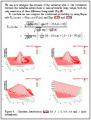
Introduction to the theory of stochastic processes and Brownian motion problems
by J. L. Garcia-Palacios
Publisher: arXiv 2007
Number of pages: 104
Description:
Contents: Historical introduction; Stochastic variables; Stochastic processes and Markov processes; The master equation: Kramers–Moyal expansion and Fokker–Planck equation; The Langevin equation; Linear response theory, dynamical susceptibilities, and relaxation times (Kramers’ theory); Methods for solving Langevin and Fokker–Planck equations; Derivation of Langevin equations in the bath-of-oscillators formalism.
Download or read it online for free here:
Download link
(1.2MB, PDF)
Similar books
 Thermodynamic Limit in Statistical Physics
by A. L. Kuzemsky - arXiv
The thermodynamic limit in statistical thermodynamics of many-particle systems is an important issue. We review the past and present disposition of thermodynamic limiting procedure in the structure of the contemporary statistical mechanics ...
(7462 views)
 Statistical Physics
by David Tong - University of Cambridge
This is an introductory course on Statistical Mechanics and Thermodynamics given to final year undergraduates. Topics: Fundamentals of Statistical Mechanics; Classical Gases; Quantum Gases; Classical Thermodynamics; Phase Transitions.
(12515 views)
 Statistical Physics
by Franz J. Vesely - University of Vienna
This web tutorial was devised as a tool for teaching Statistical Physics to second year students. Topics covered: Why is water wet? Elements of Kinetic Theory; Phase space; Statistical Thermodynamics; Statistical Quantum Mechanics.
(10135 views)
 Non-equilibrium Statistical Mechanics
by T. Chou, K. Mallick, R. K. P. Zia - arXiv
We review some of the many recent activities on non-equilibrium statistical mechanics, focusing on general aspects. Using the language of stochastic Markov processes, we emphasize general properties of the evolution of configurational probabilities.
(8320 views)