
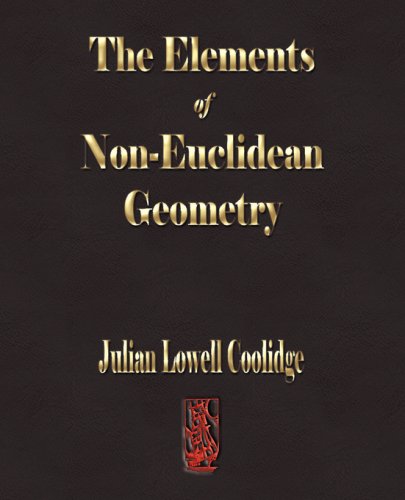
The Elements Of Non-Euclidean Geometry
by Julian Lowell Coolidge
Publisher: Oxford At The Clarendon Press 1909
ISBN/ASIN: 1603861491
Number of pages: 282
Description:
Chapters Include: Foundation For Metrical Geometry In A Limited Region; Congruent Transformations; The Three Hypotheses; The Introduction Of Trigonometric Formulae; Analytic Formulae; Consistency And Significance Of The Axioms; The Geometric And Analytic Extension Of Space; The Groups Of Congruent Transformations; Point, Line, And Plane Treated Analytically; The Higher Line Geometry; The Circle And The Sphere; Conic Sections; Quadric Surfaces; Areas And Volumes; Introduction To Differential Geometry; etc.
Download or read it online for free here:
Download link
(1.2MB, PDF)
Similar books
 The Elements of Non-Euclidean Geometry
by D.M.Y. Sommerville - G. Bell & Sons Ltd.
Renowned for its lucid yet meticulous exposition, this text follows the development of non-Euclidean geometry from a fundamental analysis of the concept of parallelism to such advanced topics as inversion and transformations.
(10757 views)
 Hyperbolic Geometry
by J.W. Cannon, W.J. Floyd, R. Kenyon, W.R. Parry - MSRI
These notes are intended as a relatively quick introduction to hyperbolic geometry. They review the wonderful history of non-Euclidean geometry. They develop a number of the properties that are particularly important in topology and group theory.
(10695 views)
 The Elements of Non-Euclidean Plane Geometry and Trigonometry
by Horatio Scott Carslaw - Longmans, Green and co.
In this book the author has attempted to treat the Elements of Non-Euclidean Plane Geometry and Trigonometry in such a way as to prove useful to teachers of Elementary Geometry in schools and colleges. Hyperbolic and elliptic geometry are covered.
(9542 views)
 Non-Euclidean Geometry: A Critical and Historical Study of its Development
by Roberto Bonola - Open Court Publishing Company
Examines various attempts to prove Euclid's parallel postulate - by the Greeks, Arabs and Renaissance mathematicians. It considers forerunners and founders such as Saccheri, Lambert, Legendre, Gauss, Schweikart, Taurinus, J. Bolyai and Lobachewsky.
(9795 views)