
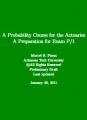
A Probability Course for the Actuaries
by Marcel B. Finan
Publisher: Arkansas Tech University 2011
Number of pages: 517
Description:
The present manuscript is designed mainly to help students prepare for the Probability Exam (Exam P/1), the first actuarial examination administered by the Society of Actuaries. This examination tests a student's knowledge of the fundamental probability tools for quantitatively assessing risk. A thorough command of calculus is assumed.
Download or read it online for free here:
Download link
(2.3MB, PDF)
Similar books
 Radically Elementary Probability Theory
by Edward Nelson - Princeton University Press
In this book Nelson develops a new approach to probability theory that is just as powerful as but much simpler than conventional Kolmogorov-style probability theory used throughout mathematics for most of the 20th century.
(17480 views)
 An Introduction to Probability and Random Processes
by Gian-Carlo Rota, Kenneth Baclawski
The purpose of the text is to learn to think probabilistically. The book starts by giving a bird's-eye view of probability, it first examines a number of the great unsolved problems of probability theory to get a feeling for the field.
(19145 views)
 Introduction to Probability
by C. M. Grinstead, J. L. Snell - American Mathematical Society
The textbook for an introductory course in probability for students of mathematics, physics, engineering, social sciences, and computer science. It presents a thorough treatment of techniques necessary for a good understanding of the subject.
(66201 views)
 Lectures on Integrable Probability
by Alexei Borodin, Vadim Gorin - arXiv
Topics include integrable models of random growth, determinantal point processes, Schur processes and Markov dynamics on them, Macdonald processes and their application to asymptotics of directed polymers in random media.
(8081 views)