
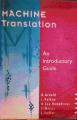
Machine Translation: an Introductory Guide
by Doug Arnold, at al.
Publisher: Blackwell Pub 1994
ISBN/ASIN: 185554217X
ISBN-13: 9781855542174
Number of pages: 200
Description:
This introductory book looks at all aspects of Machine Translation: covering questions of what it is like to use a modern Machine Translation system, through questions about how it is done, to questions of evaluating systems, and what developments can be foreseen in the near to medium future.
Download or read it online for free here:
Download link
(multiple formats)
Similar books
 Formal Language Theory for Natural Language Processing
by Shuly Wintner - ESSLLI
This text is a mild introduction to Formal Language Theory for students with little or no background in formal systems. The motivation is Natural Language Processing, and the presentation is geared towards NLP applications, with extensive examples.
(10758 views)
 Prolog and Natural-Language Analysis
by F. C. N. Pereira, S. M. Shieber - Center for the Study of Language
A concise introduction to logic programming and the logic-programming language Prolog both as vehicles for understanding elementary computational linguistics and as tools for implementing the basic components of natural-language-processing systems.
(20873 views)
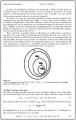 A Maximum Entropy Approach to Natural Language Processing
by A. L. Berger, S. A. Della Pietra, V. J. Della Pietra - Association for Computational Linguistics
The authors describe a method for statistical modeling based on maximum entropy. They present a maximum-likelihood approach for automatically constructing maximum entropy models and describe how to implement this approach efficiently.
(10182 views)
 Computational Linguistics
by Igor Boshakov, Alexander Gelbukh
The book focuses on the basic set of ideas and facts from the fundamental science necessary for the creation of intelligent language processing tools, without going deeply into the details of specific algorithms or toy systems.
(22297 views)