
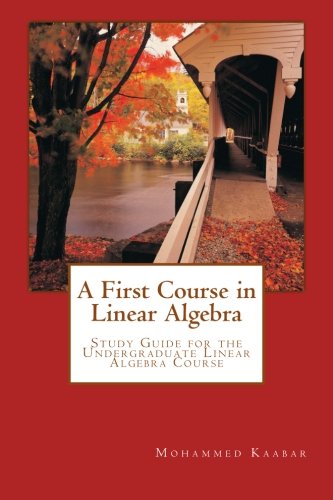
A First Course in Linear Algebra: Study Guide for the Undergraduate Linear Algebra Course
by Mohammed Kaabar
Publisher: Arxiv.org 2015
ISBN/ASIN: 1502901811
Number of pages: 132
Description:
In this book, there are five chapters: Systems of Linear Equations, Vector Spaces, Homogeneous Systems, Characteristic Equation of Matrix, and Matrix Dot Product. It has also exercises at the end of each chapter above to let students practice additional sets of problems other than examples.
Download or read it online for free here:
Download link
(1.1MB, PDF)
Similar books
 Basic Linear Algebra
by Andrew Baker - University of Glasgow
The text covers basic ideas and techniques of Linear Algebra that are applicable in many subjects including the physical and chemical sciences, and statistics. These notes were originally written for a course at the University of Glasgow.
(16325 views)
Computational and Algorithmic Linear Algebra and n-Dimensional Geometryby Katta G. Murty
A sophomore level book on linear algebra and n-dimensional geometry with the aim of developing in college entering undergraduates skills in algorithms, computational methods, and mathematical modeling. Written in a simple style with lots of examples.
(15284 views)
 Linear Algebra for Informatics
by José Figueroa-O'Farrill - The University of Edinburgh
These are the lecture notes and tutorial problems for the Linear Algebra module. The text is divided into three parts: (1) real vector spaces and their linear maps; (2) univariate polynomials; (3) introduction to algebraic coding theory.
(13446 views)
 Linear Algebra: An Introduction to Mathematical Discourse
- Wikibooks
The book was designed specifically for students who had not previously been exposed to mathematics as mathematicians view it. That is, as a subject whose goal is to rigorously prove theorems starting from clear consistent definitions.
(12571 views)