
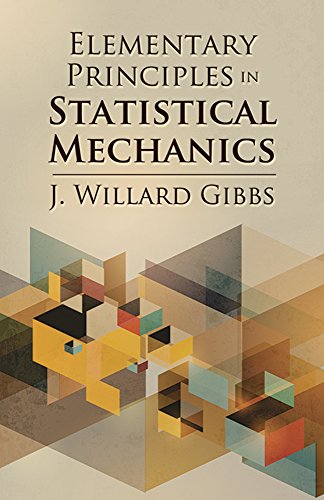
Elementary Principles of Statistical Mechanics
by Josiah Willard Gibbs
Publisher: Charles Scribner's Sons 1902
ISBN/ASIN: 0486789950
Number of pages: 273
Description:
Written by J. Willard Gibbs, the most distinguished American mathematical physicist of the nineteenth century, this book was the first to bring together and arrange in logical order the works of Clausius, Maxwell, Boltzmann, and Gibbs himself. The lucid, advanced-level text remains a valuable collection of fundamental equations and principles.
Download or read it online for free here:
Download link
(950KB, PDF)
Similar books
 Statistical Mechanics
by Daniel F. Styer - Oberlin College
This is a book about statistical mechanics at the advanced undergraduate level. It assumes a background in classical mechanics through the concept of phase space, in quantum mechanics through the Pauli exclusion principle, and multivariate calculus.
(11781 views)
 Introduction to Nonequilibrium Statistical Mechanics with Quantum Field
by Takafumi Kita - arXiv
The author presents a concise and self-contained introduction to nonequilibrium statistical mechanics with quantum field theory. Readers are assumed to be familiar with the Matsubara formalism of equilibrium statistical mechanics.
(10221 views)
 Relativistic Kinetic Theory: An Introduction
by Olivier Sarbach, Thomas Zannias - arXiv
A brief introduction to the relativistic kinetic theory of gases with emphasis on the underlying geometric and Hamiltonian structure of the theory. We start with a discussion on the tangent bundle of a Lorentzian manifold of arbitrary dimension...
(7866 views)
 Lectures on Noise Sensitivity and Percolation
by Christophe Garban, Jeffrey E. Steif - arXiv
The goal of this set of lectures is to combine two seemingly unrelated topics: (1) The study of Boolean functions, a field particularly active in computer science; (2) Some models in statistical physics, mostly percolation.
(12190 views)