
Interface-Induced Phenomena in Magnetism
by Frances Hellman, et al.
Publisher: arXiv 2016
Number of pages: 193
Description:
This article reviews static and dynamic interfacial effects in magnetism, focusing on interfacially-driven magnetic effects and phenomena associated with spin-orbit coupling and intrinsic symmetry breaking at interfaces. It provides a historical background and literature survey, but focuses on recent progress, identifying the most exciting new scientific results and pointing to promising future research directions.
Download or read it online for free here:
Download link
(3.1MB, PDF)
Similar books
 Many-body Physics with Ultracold Gases
by Immanuel Bloch, Jean Dalibard, Wilhelm Zwerger - arXiv.org
This paper reviews recent experimental and theoretical progress concerning many-body phenomena in dilute, ultracold gases. It focuses on effects beyond standard weak-coupling descriptions, such as the Mott-Hubbard transition in optical lattices, etc.
(5676 views)
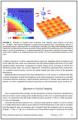 Phases and Phase Transitions in Disordered Quantum Systems
by Thomas Vojta - arXiv
These lecture notes give a pedagogical introduction to phase transitions in disordered quantum systems and to the exotic Griffiths phases induced in their vicinity. The author also presents a number of experimental examples.
(7685 views)
 The Condensed Matter Physics of QCD
by Krishna Rajagopal, Frank Wilczek - arXiv
Important progress in understanding the behavior of hadronic matter at high density has been achieved recently. We discuss the phase diagram of QCD as a function of temperature and density, and close with a look at possible astrophysical signatures.
(10609 views)
 Modern Computational Methods in Solids
by Adrian Feiguin - University of Wyoming
The purpose of this course is to introduce students to a series of paradigmatic physical problems in condensed matter, using the computer to solve them. The course will feel like a natural extension of introductory condensed matter.
(10825 views)