
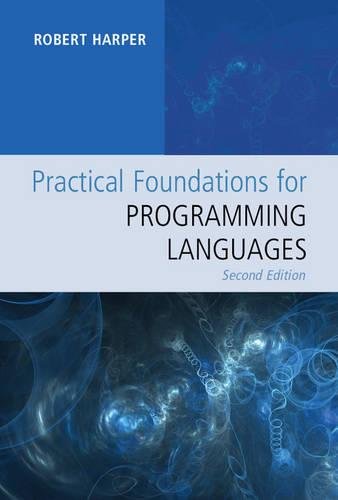
Practical Foundations for Programming Languages
by Robert Harper
Publisher: Carnegie Mellon University 2016
Number of pages: 580
Description:
This is a working draft of a book on the foundations of programming languages. The central organizing principle of the book is that programming language features may be seen as manifestations of an underlying type structure that governs its syntax and semantics. The emphasis, therefore, is on the concept of type, which codifies and organizes the computational universe in much the same way that the concept of set may be seen as an organizing principle for the mathematical universe. The purpose of this book is to explain this remark.
Download or read it online for free here:
Download link
(1.2MB, PDF)
Similar books
 Partial Evaluation and Automatic Program Generation
by Neil D. Jones, Carsten K. Gomard, Peter Sestoft - Prentice Hall
The book about partial evaluation, a program optimization technique also known as program specialization. It presents principles for constructing partial evaluators for a variety of programming languages, and gives references to the literature.
(16358 views)
 Topics in History and Comparing Programming Languages
by Dennie Van Tassel - Gavilan College
This website contains files on the history of computer programming language statements. The files compare programming language statements in several different languages tracing the statement from early languages to present languages.
(7681 views)
 Denotational Semantics: A Methodology for Language Development
by David Schmidt - Kansas State University
Denotational semantics is a methodology for giving mathematical meaning to programming languages and systems. This book was written to make denotational semantics accessible to a wider audience and to update existing texts in the area.
(12792 views)
 Lecture Notes on the Lambda Calculus
by Peter Selinger - Dalhousie University
Topics covered in these notes include the untyped lambda calculus, the Church-Rosser theorem, combinatory algebras, the simply-typed lambda calculus, the Curry-Howard isomorphism, weak and strong normalization, type inference, etc.
(12016 views)