
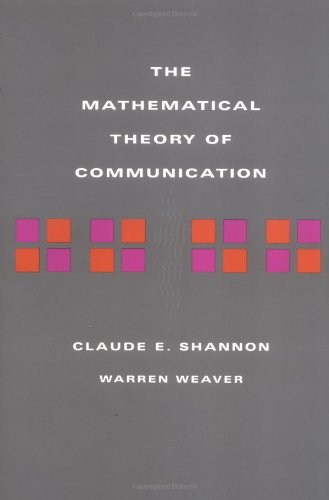
A Mathematical Theory of Communication
by Claude Shannon
1948
Number of pages: 79
Description:
The person who wrote this paper is the father of modern communication theory, Claude Shannon. In this seminal work Shannon presents results that were previously found nowhere else, and today many professors refer to it as the best exposition still on the subject of the mathematical limits on communication (such as bandwidth). Further, it laid the modern foundations for what is now coined Information Theory. Classic work.
Download or read it online for free here:
Download link
(4.4MB, PDF)
Similar books
 A primer on information theory, with applications to neuroscience
by Felix Effenberger - arXiv
This chapter is supposed to give a short introduction to the fundamentals of information theory, especially suited for people having a less firm background in mathematics and probability theory. The focus will be on neuroscientific topics.
(8764 views)
 Essential Coding Theory
by Venkatesan Guruswami, Atri Rudra, Madhu Sudan - University at Buffalo
Error-correcting codes are clever ways of representing data so that one can recover the original information even if parts of it are corrupted. The basic idea is to introduce redundancy so that the original information can be recovered ...
(9044 views)
 Information Theory and Coding
by John Daugman - University of Cambridge
The aims of this course are to introduce the principles and applications of information theory. The course will study how information is measured in terms of probability and entropy, and the relationships among conditional and joint entropies; etc.
(23467 views)
 The Limits of Mathematics
by Gregory J. Chaitin - Springer
The final version of a course on algorithmic information theory and the epistemology of mathematics. The book discusses the nature of mathematics in the light of information theory, and sustains the thesis that mathematics is quasi-empirical.
(12658 views)