
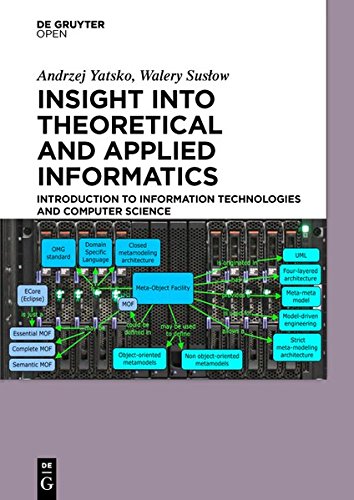
Insight into Theoretical and Applied Informatics
by Andrzej Yatsko, Walery Suslow
Publisher: De Gruyter Open 2016
ISBN/ASIN: 3110469871
ISBN-13: 9783110469875
Number of pages: 117
Description:
The book is addressed to young people interested in computer technologies and computer science. The objective of this book is to provide the reader with all the necessary elements to get him or her started in the modern field of informatics and to allow him or her to become aware of the relationship between key areas of computer science.
Download or read it online for free here:
Download link
(multiple PDF files)
Similar books
 Common LISP: A Gentle Introduction to Symbolic Computation
by David S. Touretzky - Benjamin-Cummings Pub Co
This is a gentle introduction to Common Lisp for students taking their first programming course. No prior mathematical background beyond arithmetic is assumed. There are lots of examples, the author avoided technical jargon.
(27143 views)
 Computer Science Logo Style
by Brian Harvey - The MIT Press
This series is for people who are interested in computer programming because it's fun. The three volumes use the Logo as the vehicle for an exploration of computer science from the perspective of symbolic computation and artificial intelligence.
(20254 views)
 Computer Science: Abstraction to Implementation
by Robert M. Keller - Harvey Mudd College
This book is intended for a second course in computer science, one emphasizing principles wherever it seems possible. It is not limited to programming, it attempts to use various programming models to explicate principles of computational systems.
(23922 views)
 Computer Science Concepts in Scratch
by Michal Armoni, Moti Ben-Ari - Weizmann Institute of Science
This book will familiarize you with the Scratch visual programming environment, focusing on using Scratch to learn computer science. Each concept is introduced in order to solve a specific task such as animating dancing images or building a game.
(7871 views)