
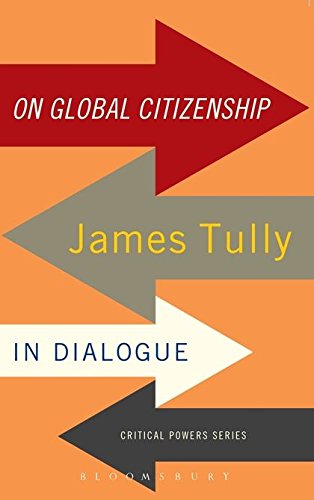
On Global Citizenship
by James Tully
Publisher: Bloomsbury Academic 2014
ISBN-13: 9781849665162
Number of pages: 369
Description:
On Global Citizenship develops James Tully's distinctive and influential approach to political philosophy, first outlined in his 2008 two-volume work Public Philosophy in a New Key, and applies it to the field of citizenship. The second part of the book contains responses from influential interlocutors including Bonnie Honig and Marc Stears, David Owen and Adam Dunn, Aletta Norval, Antony Laden, and Duncan Bell. These provide a commentary not just on the ideas contained in this volume, but on Tully's approach to political philosophy more generally, thus making the book an ideal first source for academics and students wishing to engage with Tully's work.
Download or read it online for free here:
Download link
(5.7MB, PDF)
Similar books
 Controlling Bureaucracies: Dilemmas in Democratic Governance
by Judith Gruber - University of California Press
How can citizens exercise control over government officials in ways that allow for effective government? In this book, Professor Gruber merges a sophisticated analysis with empirical research to develop a new approach to this perennial problem.
(11519 views)
 Political Concepts
by Richard Bellamy, Andrew Mason - Manchester University Press
Written by a powerful international team of theorists, this book offers a sophisticated analysis of the central political concepts in the light of recent debates in political theory. All political argument employs political concepts ...
(6967 views)
 Scientific Method of Elections
by Richard Lung - Smashwords
The sheer difficulty of genuine electoral reform is shown and explained. The defeat of democracy is also a defeat for science. Freedom and knowledge depend on each other. Therein is the remedy. I base voting method on logic of measurement...
(6418 views)
 Capitalism 3.0: A Guide to Reclaiming the Commons
by Peter Barnes - Berrett-Koehler Publishers
Barnes' idea is that we need to use a 3rd institution to develop a better form a capitalism that takes into account natural resources that are used and not accounted for. This is needed, because government has failed to do a good job in this regard.
(16322 views)