
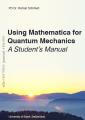
Using Mathematica for Quantum Mechanics: A Student's Manual
by Roman Schmied
Publisher: arXiv.org 2019
Number of pages: 164
Description:
This book is an attempt to help students transform all of the concepts of quantum mechanics into concrete computer representations, which can be constructed, evaluated, analyzed, and hopefully understood at a deeper level than what is possible with more abstract representations.
Download or read it online for free here:
Download link
(9.4MB, PDF)
Similar books
 A Pedestrian Introduction to the Mathematical Concepts of Quantum Physics
by Jan Govaerts - arXiv
A basic introduction to the primary mathematical concepts of quantum physics, and their physical significance, from the operator and Hilbert space point of view, highlighting more what are essentially the abstract algebraic aspects of quantization.
(14216 views)
 Symplectic Geometry of Quantum Noise
by Leonid Polterovich - arXiv
We discuss a quantum counterpart of certain constraints on Poisson brackets coming from 'hard' symplectic geometry. They can be interpreted in terms of the quantum noise of observables and their joint measurements in operational quantum mechanics.
(9609 views)
 Lecture notes on C*-algebras, Hilbert C*-modules, and quantum mechanics
by N.P. Landsman - arXiv
A graduate-level introduction to C*-algebras, Hilbert C*-modules, vector bundles, and induced representations of groups and C*-algebras, with applications to quantization theory, phase space localization, and configuration space localization.
(12971 views)
 Numerical Methods in Quantum Mechanics
by Paolo Giannozzi - University of Udine
The aim of these lecture notes is to provide an introduction to methods and techniques used in the numerical solution of simple (non-relativistic) quantum-mechanical problems, with special emphasis on atomic and condensed-matter physics.
(7933 views)