
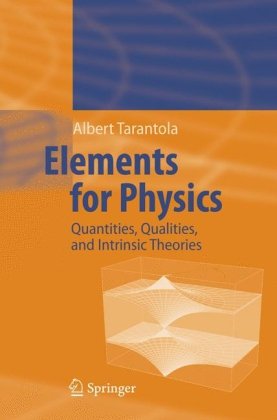
Elements for Physics: Quantities, Qualities, and Intrinsic Theories
by Albert Tarantola
Publisher: Springer 2006
ISBN/ASIN: 3540253025
ISBN-13: 9783540253020
Number of pages: 280
Description:
The book reviews and extends the theory of Lie groups, develops differential geometry, proposing compact definitions of torsion and of curvature, and adapts the usual notion of linear tangent application to the intrinsic point of view proposed for physics. As an illustration, two simple theories are studied with some detail, the theory of heat conduction and the theory of linear elastic media. The equations found differ quantitatively and qualitatively from those usually presented.
Download or read it online for free here:
Download link
(3.7MB, PDF)
Similar books
 Harmonic Oscillators and Two-by-two Matrices in Symmetry Problems in Physics
by Young Suh Kim (ed.) - MDPI AG
With a degree of exaggeration, modern physics is the physics of harmonic oscillators and two-by-two matrices. Indeed, they constitute the basic language for the symmetry problems in physics, and thus the main theme of this journal.
(6152 views)
 Random Matrix Models and Their Applications
by Pavel Bleher, Alexander Its - Cambridge University Press
The book covers broad areas such as topologic and combinatorial aspects of random matrix theory; scaling limits, universalities and phase transitions in matrix models; universalities for random polynomials; and applications to integrable systems.
(16944 views)
 Foundations Of Potential Theory
by Oliver Dimon Kellog - Springer
The present volume gives a systematic treatment of potential functions. It has a purpose to serve as an introduction for students and to provide the reader with the fundamentals of the subject, so that he may proceed immediately to the applications.
(6993 views)
 Invariance Theory, the Heat Equation and the Atiyah-Singer Index Theorem
by Peter B. Gilkey - Publish or Perish Inc.
This book treats the Atiyah-Singer index theorem using the heat equation, which gives a local formula for the index of any elliptic complex. Heat equation methods are also used to discuss Lefschetz fixed point formulas and the Gauss-Bonnet theorem.
(10504 views)