
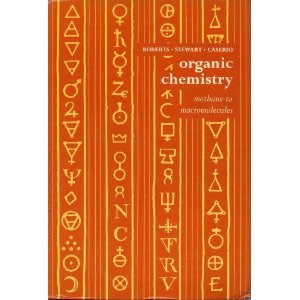
Organic Chemistry: methane to macromolecules
by J.D. Roberts, R. Stewart, M.C. Caserio
Publisher: W. A. Benjamin, Inc. 1971
ISBN/ASIN: 0805383328
ISBN-13: 9780805383324
Number of pages: 864
Description:
In the present work the authors have tried to paint an interesting, relevant, and up-to-date picture of organic chemistry while retaining the rigorous approach of the earlier books. The reader makes an acquaintance with the properties of some important organic compounds before dealing in an open-ended way with families of compounds-alkanes, alcohols, etc. A heavy emphasis on spectroscopy is retained. The simple introduction to the subject and the emphasis on relevance, particularly to living systems, should make the book appealing to the general student.
Download or read it online for free here:
Download link
(90MB, PDF)
Similar books
 Practical Organic Chemistry
by Julius Berend Cohen - Macmillan
The book does not aim at being a complete laboratory guide, but is intended to provide a systematic course of practical instruction, illustrating a great variety of reactions and processes with a very moderate outlay in materials and apparatus.
(15965 views)
 Micro- and Nano-Transport of Biomolecules
by David Bakewell - BookBoon
This ebook is generally intended for undergraduate students from chemical, life and physical sciences wanting to find out about the basic properties of biomolecules and how they can be transported in liquids on the micro- to nano-scale.
(16416 views)
 Organic Chemistry
by Amgad M. Rabie, at al. - Wikibooks
Organic chemistry is primarily devoted to the unique properties of the carbon atom and its compounds. These compounds play a critical role in biology and ecology, Earth sciences and geology, physics, industry, medicine and - of course - chemistry.
(31232 views)
 Basic Principles of Organic Chemistry, 2ed
by John D. Roberts, Marjorie C. Caserio - Addison-Wesley
A comprehensive textbook that covers the elements of modern organic chemistry with sufficient breadth to anticipate the interests and needs of the future chemists, biologists, physicians, medical scientists, and engineers.
(47500 views)