
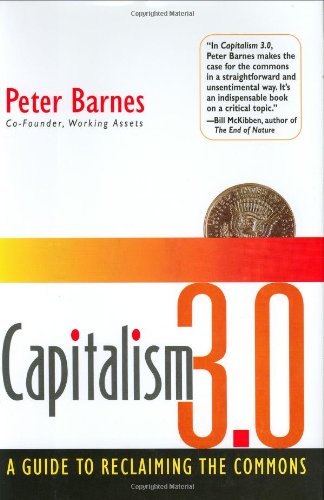
Capitalism 3.0: A Guide to Reclaiming the Commons
by Peter Barnes
Publisher: Berrett-Koehler Publishers 2006
ISBN/ASIN: 1576753611
ISBN-13: 9781576753613
Number of pages: 207
Description:
Barnes' idea is that we need to use a 3rd institution - "the commons" - to develop a better form a capitalism that takes into account natural resources that are used and not accounted for. This is needed, because government has failed to do a good job in this regard and is subject by capture by industry, something that is very prevalent in the USA. The commons works by being above the short term exigencies of businessmen and politicians, using the power of property rights under legal trusteeship to ensure that the commons under trust are best used for the long term.
Download or read it online for free here:
Download link
(0.7MB, PDF)
Similar books
 Taxes and Taxation Trends
by Jolanta Iwin-Garzynska - InTech
Taxes will always introduce risks and uncertainties in business, due to the high volatility and uncertainty of tax law. Moreover, being a category that affects the economic growth, they cause disturbances in stability and welfare of the state.
(5884 views)
 Privatization of Roads and Highways
by Walter Block - Ludwig von Mises Institute
This treatise on private roads will cause you to rethink the way modern transportation networks operate. It shows how free-market economic theory is the clarifying lens through which to see the alternative that is consistent with human liberty.
(15134 views)
 Case for Legalizing Capitalism
by Kel Kelly - Ludwig von Mises Institute
What's the American system of economics? Most people would say it is capitalism, which thereby deserves all fault when anything goes wrong. Kel Kelly responds to this myth in this comprehensive treatment of the free market and intervention.
(8541 views)
 China in the New Millennium: Market Reforms and Social Development
by James A. Dorn (ed.) - Cato Institute
The essays included in this volume examine the state of China's economic reforms, the institutional changes necessary for China to become a global economic power, and the interplay between market reforms and social development in China.
(6167 views)