
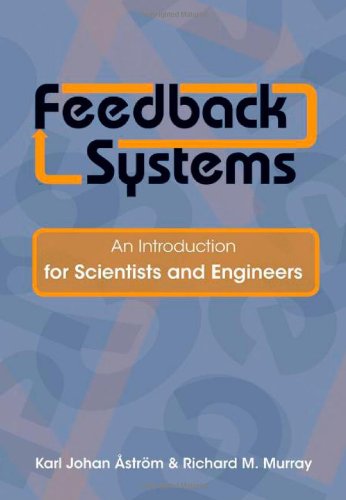
Feedback Systems: An Introduction for Scientists and Engineers
by Karl J. Astrom, Richard M. Murray
Publisher: Princeton University Press 2008
ISBN/ASIN: 0691135762
ISBN-13: 9780691135762
Number of pages: 408
Description:
This book provides an introduction to the basic principles and tools for the design and analysis of feedback systems. It is intended to serve a diverse audience of scientists and engineers who are interested in understanding and utilizing feedback in physical, biological, information and social systems. A major goal of this book is to present a concise and insightful view of the current knowledge in feedback and control systems.
Download or read it online for free here:
Download link
(11MB, PDF)
Similar books
 Chaotic Systems
by Esteban Tlelo-Cuautle - InTech
This book presents a collection of major developments in chaos systems covering aspects on chaotic behavioral modeling and simulation, control and synchronization of chaos systems, and applications like secure communications.
(11422 views)
 Applications of Nonlinear Control
by Meral Altinay - InTech
A trend of investigation of Nonlinear Control Systems has been present over the last few decades. This book includes topics such as Feedback Linearization, Lyapunov Based Control, Adaptive Control, Optimal Control and Robust Control.
(12352 views)
 High Performance Control
by T.T. Tay, I.M.Y. Mareels, J.B. Moore - Birkhauser
Using the tools of optimal control, robust control and adaptive control, the authors develop the theory of high performance control. Topics include performance enhancement, stabilizing controllers, offline controller design, and dynamical systems.
(13891 views)
 Fuzzy Control
by K. M. Passino, S. Yurkovich - Addison Wesley
Introduction to fuzzy control with a broad treatment of topics including direct fuzzy control, nonlinear analysis, identification/ estimation, adaptive and supervisory control, and applications, with many examples, exercises and design problems.
(16278 views)