
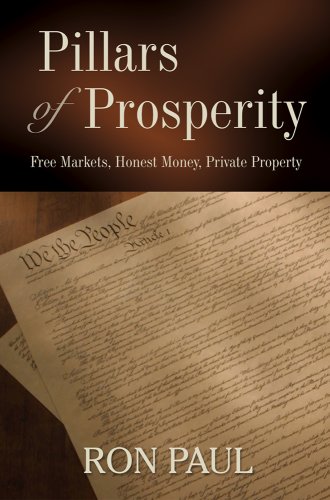
Pillars of Prosperity: Free Markets, Honest Money, Private Property
by Ron Paul
Publisher: Mises Institute 2008
ISBN/ASIN: 1933550244
ISBN-13: 9781933550244
Number of pages: 496
Description:
This economic manifesto by Ron Paul collects his greatest speeches and debates over the last 30 years, and provides documentary evidence that he is not only a master of the topic; he has provided a coherent explanation of nearly everything the government has done wrong in this area since he first entered public office. He also provides a way out, as implied by the subtitle: free market, honest money, and private property.
Download or read it online for free here:
Download link
(10MB, PDF)
Similar books
 The Origin and the Evolution of Firms: Information as a Driving Force
by J. A. Roels - IOS Press
This book develops a consistent theory of evolution in its wider sense. The author of the book traces a continuous line of evolving information sets that connect the Big-Bang to the firms and markets of our current socio-economic system.
(6480 views)
 Modeling Bounded Rationality
by Ariel Rubinstein - The MIT Press
The author considers the modeling of choice, the modeling of procedural rationality, knowledge, memory, the choice of what to know, and group decisions. The second part discusses the fundamental difficulties of modeling bounded rationality in games.
(14020 views)
 Cook-Book Of Mathematics
by Viatcheslav Vinogradov - CERGE-EI
Simple recipes for solving problems students might face in their studies of economics. The main goal was to refresh students' knowledge of mathematics rather than teach them math from scratch, BA level mathematics is required.
(24974 views)
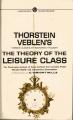 The Theory of the Leisure Class
by Thorstein Veblen
Classic of economic and social theory offers a satiric examination of the hollowness and falsity suggested by the term 'conspicuous consumption', exposing the emptiness of many cherished standards of taste, education, dress, and culture.
(11542 views)