
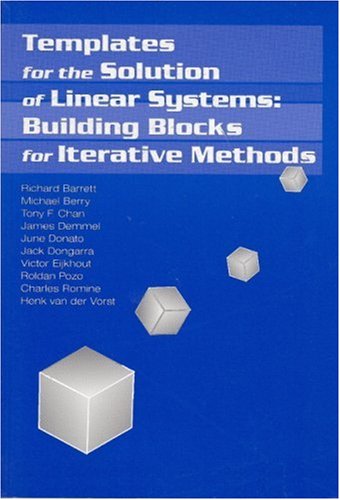
Templates for the Solution of Linear Systems
by Richard Barrett et al.
Publisher: Society for Industrial Mathematics 1987
ISBN/ASIN: 0898713285
ISBN-13: 9780898713282
Number of pages: 117
Description:
In this book, which focuses on the use of iterative methods for solving large sparse systems of linear equations, templates are introduced to meet the needs of both the traditional user and the high-performance specialist. Templates, a description of a general algorithm rather than the executable object or source code more commonly found in a conventional software library, offer whatever degree of customization the user may desire.
Download or read it online for free here:
Download link
(740 KB, PDF)
Similar books
 Notes on Linear Algebra
by Peter J. Cameron - Queen Mary, University of London
On the theoretical side, we deal with vector spaces, linear maps, and bilinear forms. On the practical side, the subject is really about one thing: matrices. This module is a mixture of abstract theory and concrete calculations with matrices.
(12703 views)
 Linear Algebra Review and Reference
by Zico Kolter - Stanford University
From the tabble of contents: Basic Concepts and Notation; Matrix Multiplication; Operations and Properties; Matrix Calculus (Gradients and Hessians of Quadratic and Linear Functions, Least Squares, Eigenvalues as Optimization, etc.).
(19591 views)
 The Theory of Determinants and Their Applications
by Robert Forsyth Scott - Cambridge University Press
In the present treatise I have attempted to give an exposition of the Theory of Determinants and their more important applications. The treatise uses Grassmann's alternate units, by means of which the study of determinants is much simplified.
(5761 views)
 n-Linear Algebra of Type II
by W. B. V. Kandasamy, F. Smarandache - InfoLearnQuest
This book is a continuation of the book n-linear algebra of type I. Most of the properties that could not be derived or defined for n-linear algebra of type I is made possible in this new structure which is introduced in this book.
(12890 views)