
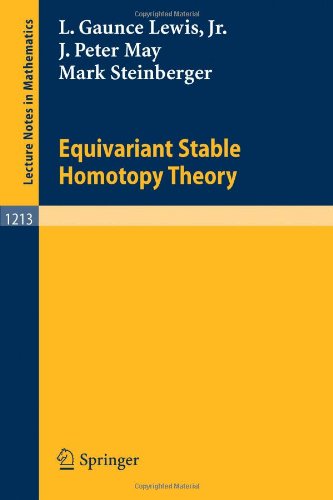
Equivariant Stable Homotopy Theory
by G. Jr. Lewis, J. P. May, M. Steinberger, J. E. McClure
Publisher: Springer 1986
ISBN/ASIN: 3540168206
ISBN-13: 9783540168201
Number of pages: 538
Description:
Our primary purpose in this volume is to establish the foundations of equivariant stable homotopy theory. To this end, we shall construct a stable homotopy category of G-spectra enjoying all of the good properties one might reasonably expect, where G is a compact Lie group. We shall use this category to study equivariant duality, equivariant transfer, the Burnside ring, and related topics in equivariant homology and cohomology theory.
Download or read it online for free here:
Download link
(30MB, PDF)
Similar books
 The Geometry of Iterated Loop Spaces
by J. P. May - Springer
A paper devoted to the study of iterated loop spaces. Our goal is to develop a simple and coherent theory which encompasses most of the known results about such spaces. We begin with some history and a description of the desiderata of such a theory.
(10726 views)
 scl
sclby Danny Calegari - Mathematical Society of Japan
This is a comprehensive introduction to the theory of stable commutator length, an important subfield of quantitative topology, with substantial connections to 2-manifolds, dynamics, geometric group theory, bounded cohomology, symplectic topology.
(10251 views)
 Topology Lecture Notes
by Thomas Ward - UEA
Contents: Topological and Metric Spaces, Homotopy Exquivalence, Fundamental Groups, Covering Spaces and Applications, Classification of Surfaces, Simplicial Complexes and Homology Groups, Homology Calculations, Simplicial Approximation, etc.
(11754 views)
 Differential Forms and Cohomology: Course
by Peter Saveliev - Intelligent Perception
Differential forms provide a modern view of calculus. They also give you a start with algebraic topology in the sense that one can extract topological information about a manifold from its space of differential forms. It is called cohomology.
(8431 views)