
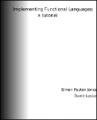
Implementing Functional Languages: a tutorial
by Simon Peyton Jones, David Lester
Publisher: Prentice Hall 1992
ISBN/ASIN: B001UHUR8W
Number of pages: 296
Description:
This book gives a practical approach to understanding implementations of non-strict functional languages using lazy graph reduction. The book is intended to be a source of practical labwork material, to help make functional-language implementations 'come alive', by helping the reader to develop, modify and experiment with some non-trivial compilers.
Download or read it online for free here:
Download link
(multiple formats)
Similar books
 Lecture Notes on Static Analysis
by Michael I. Schwartzbach - IT University of Copenhagen
These notes present principles and applications of static analysis of programs. We cover type analysis, lattice theory, control flow graphs, dataflow analysis, fixed-point algorithms, narrowing and widening, control flow analysis, pointer analysis.
(8037 views)
 Computational Category Theory
by D.E. Rydeheard, R.M. Burstall
The book is a bridge-building exercise between computer programming and category theory. Basic constructions of category theory are expressed as computer programs. It is a first attempt at connecting the abstract mathematics with concrete programs.
(19077 views)
Type Systems for Programming Languagesby Robert Harper
Provides an account of the role of type theory in programming language design and implementation. The stress is on the use of types as a tool for analyzing programming language features and studying their implementation.
(16363 views)
 Semantics With Applications: A Formal Introduction
by Hanne Riis Nielson, Flemming Nielson - John Wiley & Sons
The book covers the foundations of structural operational semantics and natural semantics. It shows how to describe the semantics of declarative as well as imperative language constructs and will also touch upon non-sequential constructs.
(13582 views)