
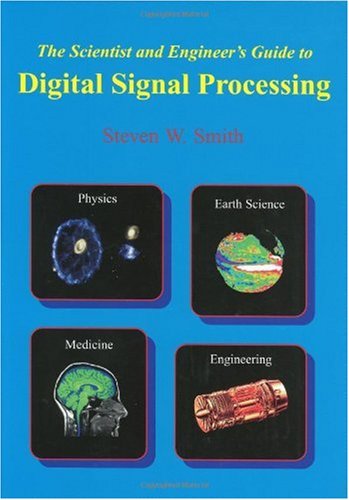
The Scientist and Engineer's Guide to Digital Signal Processing
by Steven W. Smith
Publisher: California technical Publishing 1999
ISBN/ASIN: 0966017633
ISBN-13: 9780966017632
Number of pages: 650
Description:
Digital Signal Processing is one of the most powerful technologies that will shape science and engineering in the twenty-first century. The book presents the fundamentals of DSP using examples from common science and engineering problems.
Download or read it online for free here:
Download link
(multiple PDF files)
Similar books
 An Exploration of Random Processes for Engineers
by Bruce Hajek - University of Illinois at Urbana-Champaign
These notes were written for a graduate course on random processes. Students are assumed to have had a previous course in probability, some familiarity with real analysis and linear algebra, and some familiarity with complex analysis.
(15482 views)
 The Fundamentals of Signal Analysis
- Agilent Technologies
This text is a primer for those who are unfamiliar with the advantages of analysis in the frequency and modal domains and Dynamic Signal Analyzers. The authors avoid the use of rigorous mathematics and instead depend on heuristic arguments.
(13493 views)
 Fourier Transforms: High-tech Application and Current Trends
by G. Nikolic, M. Cakic, D. Cvetkovic (eds) - InTech
The book provides a review on recent advances in Fourier transforms as the most powerful analytical tool for applications in electronic and computer engineering, as well as spectral techniques with a wide range of nanotechnological applications.
(6653 views)
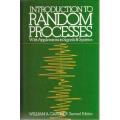 Introduction To Random Processes
by William A. Gardner - McGraw-Hill
A first course on random processes for graduate engineering and science students, particularly those with an interest in the analysis and design of signals and systems. The book includes detailed coverage of minimum-mean-squared-error estimation.
(12836 views)