
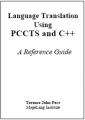
Language Translation Using PCCTS and C++
by Terence John Parr
Publisher: Automata Publishing Company 1993
Number of pages: 310
Description:
This book is a reference guide for the parser generator ANTLR, ANother Tool for Language Recognition, and the tree-parser generator SORCERER, which is suited to source-to-source translation. It is intended as a reference manual not a textbook or how-to book on language translation. The book is valuable to any scientist, engineer, or programmer who has to translate, evaluate, interpret, manipulate or otherwise examine data or language statements of any kind.
Download or read it online for free here:
Download link
(900KB, PDF)
Similar books
 Taligent's Guide to Designing Programs
- Taligent Press
Well-Mannered object-oriented design in C++: this is a brief overview of object-oriented program design, focusing on operating-system development. The text will be of interest to the C++ programmers who need a quick summary of good OOP techniques.
(21090 views)
 Programming the Be Operating System
by Dan Parks Sydow - O'Reilly
This book gives C++ programmers their start to developing the applications on Be operating system. The book begins with simple programs and gradually adds elements of the graphical interface. It carefully describes drawing and message handling.
(23132 views)
 Optimizing C ++
by Steve Heller - Prentice Hall PTR
The book provides C++ programmers with a practical approach to code optimization. The text consists of case studies of database problems with various searching and compression algorithms, the source code, and explanation of the solutions.
(19505 views)
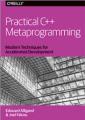 Practical C++ Metaprogramming
- O'Reilly Media
C++ template metaprogramming is ideal for performing automatic compile-time optimization. With this ebook, you'll learn how improved metaprogramming techniques in C++11 and C++14 can help you avoid mistakes by making the compiler work for you.
(13813 views)