
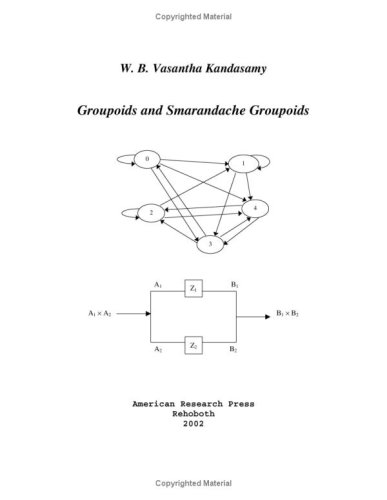
Groupoids and Smarandache Groupoids
by W. B. Vasantha Kandasamy
Publisher: American Research Press 2002
ISBN/ASIN: 1931233616
ISBN-13: 9781931233613
Number of pages: 115
Description:
This book aims to give a systematic development of the basic non-associative algebraic structures viz. Smarandache groupoids. Smarandache groupoids exhibits simultaneously the properties of a semigroup and a groupoid. Such a combined study of an associative and a non associative structure has not been so far carried out.
Download or read it online for free here:
Download link
(570KB, PDF)
Similar books
 An Elementary Introduction to Group Theory
by M. E. Charkani - AMS
The theory of groups is a branch of mathematics in which we study the concept of binaryoperations. Group theory has many applications in physics and chemistry, and is potentially applicable in any situation characterized by symmetry.
(7008 views)
 Lectures on Algebraic Groups
by Alexander Kleshchev - University of Oregon
Contents: General Algebra; Commutative Algebra; Affine and Projective Algebraic Sets; Varieties; Morphisms; Tangent spaces; Complete Varieties; Basic Concepts; Lie algebra of an algebraic group; Quotients; Semisimple and unipotent elements; etc.
(13062 views)
 Frobenius Splittings and B-Modules
by Wilberd van der Kallen - Springer
The course given by the author in 1992 explains the solution by O. Mathieu of some conjectures in the representation theory of arbitrary semisimple algebraic groups. The conjectures concern filtrations of 'standard' representations.
(9033 views)
 Introduction to Groups, Invariants and Particles
by Frank W. K. Firk - Orange Grove Texts Plus
This is an introduction to group theory, with an emphasis on Lie groups and their application to the study of symmetries of the fundamental constituents of matter. The text was written for seniors and advanced juniors, majoring in the physical sciences.
(19593 views)