
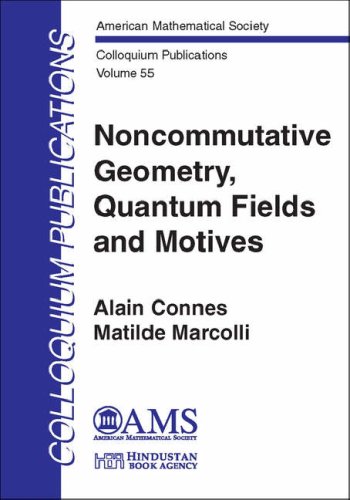
Noncommutative Geometry, Quantum Fields and Motives
by Alain Connes, Matilde Marcolli
Publisher: American Mathematical Society 2007
ISBN/ASIN: 0821842102
ISBN-13: 9780821842102
Number of pages: 705
Description:
The unifying theme of this book is the interplay among noncommutative geometry, physics, and number theory. The two main objects of investigation are spaces where both the noncommutative and the motivic aspects come to play a role: space-time, where the guiding principle is the problem of developing a quantum theory of gravity, and the space of primes, where one can regard the Riemann Hypothesis as a long-standing problem motivating the development of new geometric tools.
Download or read it online for free here:
Download link
(6.4MB, PDF)
Similar books
 First Steps Towards a Symplectic Dynamics
by Barney Bramham, Helmut Hofer - arXiv
Both dynamical systems and symplectic geometry have rich theories and the time seems ripe to develop the common core with integrated ideas from both fields. We discuss problems which show how dynamical systems and symplectic ideas come together.
(11623 views)
 The Geometrization of Physics
by Richard S. Palais - University of California at Irvine
The major goal of these notes is to develop an observation that not only can gauge fields of the Yang-Mills type be unified with the Einstein model of gravitation, but also that when this unification is made they are described by pure geometry.
(12804 views)
 Lectures on complex geometry, Calabi-Yau manifolds and toric geometry
by Vincent Bouchard - arXiv
These are introductory lecture notes on complex geometry, Calabi-Yau manifolds and toric geometry. We first define basic concepts of complex and Kahler geometry. We then proceed with an analysis of various definitions of Calabi-Yau manifolds.
(9227 views)
 Differential Geometry in Physics
by Gabriel Lugo - University of North Carolina at Wilmington
These notes were developed as a supplement to a course on Differential Geometry at the advanced undergraduate level, which the author has taught. This texts has an early introduction to differential forms and their applications to Physics.
(18904 views)