
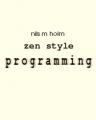
Zen Style Programming
by Nils M Holm
Publisher: Lulu Press 2008
Number of pages: 336
Description:
The first part of this book introduces the concept of functional programming, describes a language that fulfills all the requirements, and shows how to solve simple problems in it. The second part of the book shows how to apply the techniques of the first part to some problems of varying complexity. The third part, finally, shows how to implement the abstraction layer that is necessary for solving problems in an abstract way on a concrete computer.
Download or read it online for free here:
Read online
(online reading)
Similar books
 The Craft of Programming
by John C. Reynolds - Prentice Hall
Read this book if you need a much deeper understanding of programming: the need to carefully structure a program to avoid being overwhelmed by its complexity, or the need to insure reliability beyond what can he achieved by debugging.
(23380 views)
 Foundations of Computer Science
by Lawrence C Paulson - University of Cambridge
This text teaches programming and presents some fundamental principles of computer science, especially algorithm design. The programming in this course is based on the language ML and mostly concerns the functional programming style.
(23257 views)
 Concepts, Techniques, and Models of Computer Programming
by Peter Van Roy, Seif Haridi - The MIT Press
Covered topics: concurrency, state, distributed programming, constraint programming, formal semantics, declarative concurrency, message-passing concurrency, forms of data abstraction, building GUIs, transparency approach to distributed programming.
(25939 views)
 The Little Introduction To Programming
by Karl Seguin - codingintro.com
This book will teach you the fundamentals of programming and act as a foundation for whatever your programming goals may be. Rather than ignore complexities, we will face them head-on, in small steps, and unshroud the mysteries of computer language.
(16092 views)