
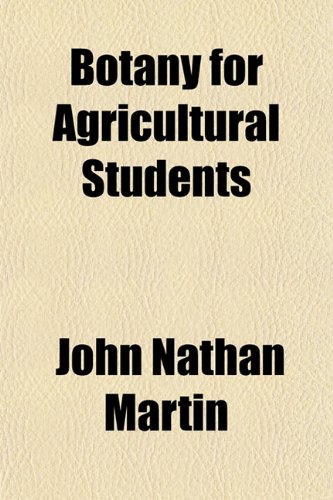
Botany for Agricultural Students
by John Nathan Martin
Publisher: Wiley 1919
ISBN/ASIN: 1151927430
Number of pages: 616
Description:
This book is intended for elementary courses in Botany in colleges and universities. In its preparation the aim has been to present the fundamental principles of Botany with emphasis upon the practical application of these principles. The subject matter is presented in two parts, part I being devoted to the study of the structures and functions chiefly of Flowering Plants, and Part II, to the study of the kinds of plants, relationships, Evolution, Heredity, and Plant Breeding.
Download or read it online for free here:
Download link
(multiple formats)
Similar books
 Hydroculture
- Wikibooks
This book demonstrates the fundamentals and advanced topics of hydroculture gardening including: aquaponics, hydroponics, aquascaping, aeroponics, passive-hydroponics, hydroculture related gardening, root zone basics, plant nutrition fundamentals.
(11549 views)
 Agriculture for Beginners
by Charles William Burkett - Ginn and Company
The art of farming is based on the sciences dealing with the growth of plants and animals. This book presents these scientific truths and suggests some practices drawn from them. You will find here many practical exercises and experiments.
(14086 views)
 Soybean: Applications and Technology
by Tzi-Bun Ng - InTech
Soybean is an agricultural crop of tremendous economic importance. Soybean and food items derived from it form dietary components of numerous people. Health benefits of soybean have attracted the attention of nutritionists as well as common people.
(11471 views)
 Toward a Sustainable Agriculture: Farming Practices and Water Use
by Henry Jordaan, Manfred Max Bergman (eds) - MDPI AG
The authors explore risks and potential solutions to inform producers and policy makers regarding practices towards sustainable production, and regarding the sustainable use of freshwater in agricultural production in a context of a changing climate.
(7500 views)