
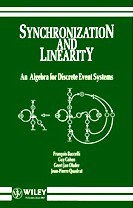
Synchronization and Linearity: An Algebra for Discrete Event Systems
by F. Baccelli, G. Cohen, G. J. Olsder, J. Quadrat
Publisher: John Wiley & Sons 1993
ISBN/ASIN: 047193609X
ISBN-13: 9780471936091
Number of pages: 501
Description:
This text presents new modelling and analysis techniques for the description of discrete event dynamic systems, emphasizing timing and synchronization aspects. Created within the text is a calculus which allows the derivation of analytical tools for computing the time behavior of this type of dynamic system.
Download or read it online for free here:
Download link
(4.1MB, PDF)
Similar books
 Fuzzy Systems
by Ahmad Taher Azar - InTech
This book is intended to present fuzzy logic systems and useful applications with a simple approach. It is written at a level suitable for use in a graduate course on applications of fuzzy systems in decision support, nonlinear modeling and control.
(11851 views)
 From Algorithms to Z-Scores: Probabilistic and Statistical Modeling in Computer Science
by Norm Matlo ff - University of California, Davis
The materials here form a textbook for a course in mathematical probability and statistics for computer science students. Computer science examples are used throughout, in areas such as: computer networks; data and text mining; computer security...
(9268 views)
 Physical Modeling in MATLAB
by Allen Downey - Green Tea Press
An introductory textbook for people who have not programmed before. Covers basic MATLAB programming with emphasis on modeling and simulation of physical systems. The book starts with scalar values and works up to vectors and matrices very gradually.
(16425 views)
 Understanding Computer Simulation
by Roger McHaney - BookBoon
Contents: Introduction to Computer Simulation; Simulation Languages; Applications of Simulation; Starting a Simulation the Right Way; Simulation Quality and Development; Developing a Simulation-Implementation; Case Study: DePorres Tours.
(15485 views)