
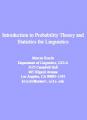
Introduction to Probability Theory and Statistics for Linguistics
by Marcus Kracht
Publisher: UCLA 2005
Number of pages: 137
Description:
Contents: Basic Probability Theory (Probability Spaces, Conditional Probability, Random Variables, Expected Word Length, Limit Theorems); Elements of Statistics (Estimators, Tests, Distributions, Correlation and Covariance, Linear Regression, Markov Chains); Probabilistic Linguistics (Probabilistic Regular Languages and Hidden Markov Models).
Download or read it online for free here:
Download link
(440KB, PDF)
Similar books
 Markov Chains and Stochastic Stability
by S.P. Meyn, R.L. Tweedie - Springer
The book on the theory of general state space Markov chains, and its application to time series analysis, operations research and systems and control theory. An advanced graduate text and a monograph treating the stability of Markov chains.
(22230 views)
 Applied Nonparametric Regression
by Wolfgang Härdle - Cambridge University Press
Nonparametric regression analysis has become central to economic theory. Hardle, by writing the first comprehensive and accessible book on the subject, contributed enormously to making nonparametric regression equally central to econometric practice.
(27257 views)
 Probability and Statistics: A Course for Physicists and Engineers
by Arak M. Mathai, Hans J. Haubold - De Gruyter Open
This is an introduction to concepts of probability theory, probability distributions relevant in the applied sciences, as well as basics of sampling distributions, estimation and hypothesis testing. Designed for students in engineering and physics.
(9057 views)
 Lectures on Probability, Statistics and Econometrics
by Marco Taboga - statlect.com
This e-book is organized as a website that provides access to a series of lectures on fundamentals of probability, statistics and econometrics, as well as to a number of exercises on the same topics. The level is intermediate.
(15144 views)