
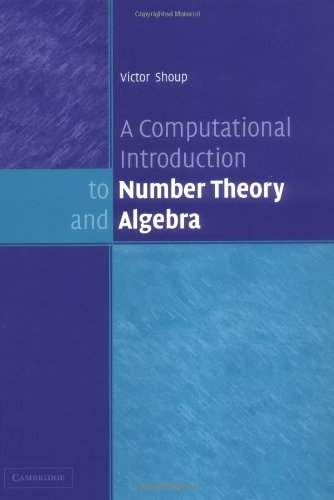
A Computational Introduction to Number Theory and Algebra
by Victor Shoup
Publisher: Cambridge University Press 2005
ISBN/ASIN: 0521851548
ISBN-13: 9780521851541
Number of pages: 534
Description:
Number theory and algebra play an increasingly significant role in computing and communications, as evidenced by the striking applications of these subjects to such fields as cryptography and coding theory. This introductory book emphasises algorithms and applications, such as cryptography and error correcting codes, and is accessible to a broad audience. The mathematical prerequisites are minimal: nothing beyond material in a typical undergraduate course in calculus is presumed, other than some experience in doing proofs - everything else is developed from scratch.
Download or read it online for free here:
Download link
(3.5MB, PDF)
Similar books
 Pictures of Julia and Mandelbrot Sets
- Wikibooks
The purpose of this book is to show how the computer can draw technically perfect pictures of Julia and Mandelbrot sets. All the necessary theory is explained and some words are said about how to put the things into a computer program.
(15727 views)
 Probabilistic Programming and Bayesian Methods for Hackers
by Cameron Davidson-Pilon - GitHub, Inc.
This book is designed as an introduction to Bayesian inference from a computational understanding-first, and mathematics-second, point of view. The book assumes no prior knowledge of Bayesian inference nor probabilistic programming.
(23019 views)
 Numerical Algorithms: Methods for Computer Vision, Machine Learning, and Graphics
by Justin Solomon - CRC Press
Using examples from a broad base of computational tasks, including data processing and computational photography, the book introduces numerical modeling and algorithmic design from a practical standpoint and provides insight into theoretical tools.
(9932 views)
 Mathematics for Algorithm and Systems Analysis
by Edward A. Bender, S. Gill Williamson - Dover Publications
This text assists undergraduates in mastering the mathematical language to address problems in the field's many applications. It consists of 4 units: counting and listing, functions, decision trees and recursion, and basic concepts of graph theory.
(31512 views)