
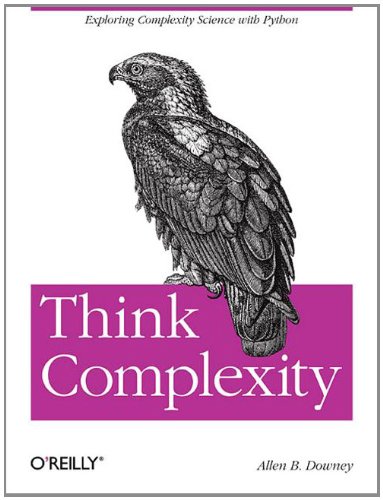
Think Complexity: Complexity Science and Computational Modeling
by Allen B. Downey
Publisher: Green Tea Press 2012
ISBN/ASIN: 1449314635
Number of pages: 146
Description:
This book is about complexity science, data structures and algorithms, intermediate programming in Python, and the philosophy of science. The book focuses on discrete models, which include graphs, cellular automata, and agent-based models. They are often characterized by structure, rules and transitions rather than by equations.
Download or read it online for free here:
Download link
(1.2MB, PDF)
Similar books
 Algorithmic Randomness and Complexity
by R. G. Downey, D. R. Hirschfeldt - Springer
Computability and complexity theory are two central areas of research in theoretical computer science. This book provides a systematic, technical development of algorithmic randomness and complexity for scientists from diverse fields.
(10046 views)
 Computability and Complexity
- Wikibooks
This book is intended as an introductory textbook in Computability Theory and Complexity Theory, with an emphasis on Formal Languages. Its target audience is CS and Math students with some background in programming and data structures.
(8860 views)
 Introduction to Computational Complexity
by Martin Tompa
Lecture notes for a graduate course on computational complexity taught at the University of Washington. Alternating Turing machines are introduced very early, and deterministic and nondeterministic Turing machines treated as special cases.
(9583 views)
 Specifying Systems
by Leslie Lamport - Addison-Wesley Professional
This book shows how to write unambiguous specifications of complex computer systems. It provides a complete reference manual for the TLA+, the language developed by the author for writing simple and elegant specifications of algorithms and protocols.
(15606 views)