
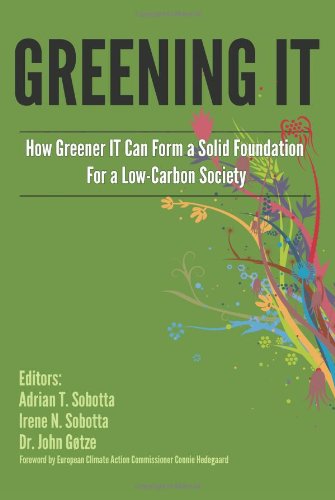
Greening IT
by Adrian Thomas Sobotta, et al.
Publisher: Greening IT Initiative 2010
ISBN/ASIN: 8791936020
ISBN-13: 9788791936029
Number of pages: 283
Description:
IT industry can provide the technological solutions we need to optimise resource use, save energy and reduce greenhouse gas emissions. We call this Greening IT. This book looks into the great potential of greening society with IT - i.e. the potential of IT in transforming our societies into Low-Carbon societies.
Download or read it online for free here:
Download link
(multiple formats)
Similar books
 Environmental Land Use Planning
by Seth Appiah-Opoku (ed.) - InTech
The book discusses such issues as predicting changes in land use pattern, ecological footprint analysis, socioeconomic and behavioral modeling, and flood control approaches. It is an important reference material on environmental management.
(11685 views)
 Concise Hydraulics
by Dawei Han - BookBoon
Introductory textbook on hydraulics written for undergraduate students in civil and environmental engineering, environmental science and geography. The aim of this book is to provide a concise and comprehensive coverage of hydraulics.
(18834 views)
 Air Quality: New Perspective
by G.L. Badilla, B. Valdez, M. Schorr (ed.) - InTech
This book is reporting air pollution of interest to experts in industrial plants dealing with the environmental issues. The authors emphasize the problems of air pollution involving the human sector as a part in the control of air pollutants.
(9908 views)
 Recycling Materials Based on Environmentally Friendly Techniques
by Dimitris S. Achilias (ed.) - InTech
There is a great need in finding of environmentally friendly recycling techniques. The intention of this book is to present some recent methods for the recycling of several materials, as well as to show the importance of composting of polymers.
(9228 views)