
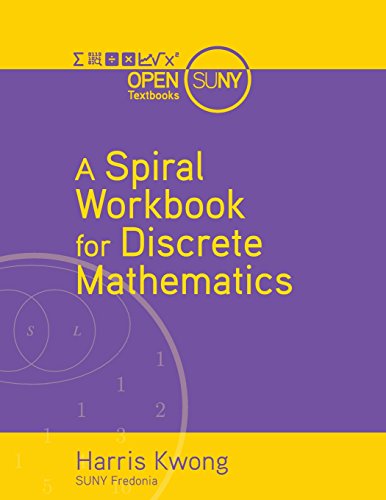
A Spiral Workbook for Discrete Mathematics
by Harris Kwong
Publisher: Open SUNY Textbooks 2015
ISBN/ASIN: 1942341180
Number of pages: 307
Description:
This is a text that covers the standard topics in a sophomore-level course in discrete mathematics: logic, sets, proof techniques, basic number theory, functions, relations, and elementary combinatorics, with an emphasis on motivation. It explains and clarifies the unwritten conventions in mathematics, and guides the students through a detailed discussion on how a proof is revised from its draft to a final polished form.
Download or read it online for free here:
Download link
(1.9MB, PDF)
Similar books
 Advances in Discrete Differential Geometry
by Alexander I. Bobenko (ed.) - Springer
This is the book on a newly emerging field of discrete differential geometry. It surveys the fascinating connections between discrete models in differential geometry and complex analysis, integrable systems and applications in computer graphics.
(8372 views)
 Lists, Decisions, and Graphs
by Edward A. Bender, S. Gill Williamson - University of California, San Diego
In this book, four basic areas of discrete mathematics are presented: Counting and Listing, Functions, Decision Trees and Recursion, and Basic Concepts in Graph Theory. At the end of each unit is a list of Multiple Choice Questions for Review.
(7503 views)
 Discrete Mathematics for Computer Science
by Jean Gallier - arXiv
These are notes on discrete mathematics for computer scientists. The presentation is somewhat unconventional. I emphasize partial functions more than usual, and I provide a fairly complete account of the basic concepts of graph theory.
(15716 views)
 Discrete Structures
by Vladlen Koltun - Stanford University
Contents: Sets and Notation; Induction; More Proof Techniques; Divisibility; Prime Numbers; Modular Arithmetic; Relations and Functions; Mathematical Logic; Counting; Binomial Coefficients; Inclusion-Exclusion Principle; Pigeonhole Principle; etc.
(12143 views)