
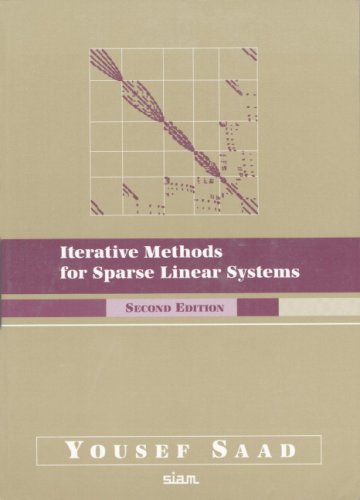
Iterative Methods for Sparse Linear Systems
by Yousef Saad
Publisher: PWS 1996
ISBN/ASIN: 0898715342
Description:
The book gives an in-depth, up-to-date view of practical algorithms for solving large-scale linear systems of equations. These equations can number in the millions and are sparse in the sense that each involves only a small number of unknowns. The methods described are iterative, i.e., they provide sequences of approximations that will converge to the solution.
Download or read it online for free here:
Download link
(multiple formats)
Similar books
 Fundamental Numerical Methods and Data Analysis
by George W. Collins, II - NASA ADS
'Fundamental Numerical Methods and Data Analysis' can serve as the basis for a wide range of courses that discuss numerical methods used in science. The author provides examples of the more difficult algorithms integrated into the text.
(17664 views)
 Lectures on Numerical Methods in Bifurcation Problems
by H.B. Keller - Tata Institute Of Fundamental Research
These lectures introduce the modern theory and practical numerical methods for continuation of solutions of nonlinear problems depending upon parameters. The treatment is elementary, advanced calculus and linear algebra are the omly prerequisites.
(9073 views)
 Numerical Methods Course Notes
by Steven E. Pav - University of California at San Diego
From the table of contents: A 'Crash' Course in octave/Matlab; Solving Linear Systems; Finding Roots; Interpolation; Spline Interpolation; Approximating Derivatives; Integrals and Quadrature; Least Squares; Ordinary Differential Equations.
(15508 views)
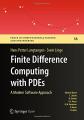 Finite Difference Computing with PDEs
by Hans Petter Langtangen, Svein Linge - Springer
This easy-to-read book introduces the basics of solving partial differential equations by means of finite difference methods. Unlike many of the traditional academic works on the topic, this book was written for practitioners.
(6106 views)