
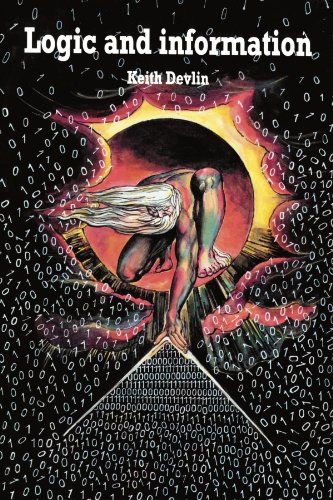
Logic and Information
by Keith Devlin
Publisher: ESSLLI 2001
ISBN/ASIN: 0521499712
Description:
An introductory, comparative account of three mathematical approaches to information: the classical quantitative theory of Claude Shannon, developed in the 1940s and 50s, a quantitative-based, qualitative theory developed by Fred Dretske in the 1970s, and a qualitative theory introduced by Jon Barwise and John Perry in the early 1980s and pursued by Barwise, Israel, Devlin, Seligman and others in the 1990s.
Download or read it online for free here:
Download link
(multiple PDF files)
Similar books
 From Classical to Quantum Shannon Theory
by Mark M. Wilde - arXiv
The aim of this book is to develop 'from the ground up' many of the major developments in quantum Shannon theory. We study quantum mechanics for quantum information theory, we give important unit protocols of teleportation, super-dense coding, etc.
(10924 views)
 The Limits of Mathematics
by Gregory J. Chaitin - Springer
The final version of a course on algorithmic information theory and the epistemology of mathematics. The book discusses the nature of mathematics in the light of information theory, and sustains the thesis that mathematics is quasi-empirical.
(12703 views)
 Error-Correction Coding and Decoding
by Martin Tomlinson, et al. - Springer
This book discusses both the theory and practical applications of self-correcting data, commonly known as error-correcting codes. The applications included demonstrate the importance of these codes in a wide range of everyday technologies.
(6707 views)
 Information Theory, Excess Entropy and Statistical Complexity
by David Feldman - College of the Atlantic
This e-book is a brief tutorial on information theory, excess entropy and statistical complexity. From the table of contents: Background in Information Theory; Entropy Density and Excess Entropy; Computational Mechanics.
(13673 views)