
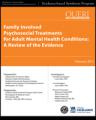
Family Involved Psychosocial Treatments for Adult Mental Health Conditions
by Laura Meis, et al.
Publisher: Department of Veterans Affairs 2012
Number of pages: 210
Description:
Consistent with prior work defining empirically supported psychological treatments, we conducted a systematic review of the published evidence evaluating if (and which) family involved treatments improve patient outcomes (i.e., efficacy) and if (and which) family involved treatments are superior to alternative interventions (i.e., specificity or comparative effectiveness, especially those therapies that include solely the patient, not family members).
Download or read it online for free here:
Download link
(1.8MB, PDF)
Similar books
 Family Physician Guide: For Depression, Anxiety Disorders, Early Psychosis
- Simon Fraser University
In order to support best practices in mental health and addictions services, accurate and up-to-date information is required by family physicians who are frequently involved in assessment, support, and treatment of these problems.
(6603 views)
 Borderline Personality Disorder: Treatment and Management
- British Psychological Society
This guideline, commissioned by NICE and developed by the National Collaborating Centre for Mental Health, sets out clear, evidence- and consensus-based recommendations for healthcare staff on how to treat and manage borderline personality disorder.
(13236 views)
 Psychotherapy
by Hugo Münsterberg - Moffat, Yard and Co.
I want to counteract the misunderstandings which overflood the whole field, especially by the mixing of mental and moral influence. I want to strengthen the public feeling that the time has come when every physician should study psychology.
(10369 views)
 Risk Factors For Suicide
- National Academies Press
Thoughts of suicide can be abundant and frequent for some. These thoughts easily disrupt the lives of not only the suicidal person but the world around said person. It may, however, be possible to tell someone is suicidal before it's too late.
(8778 views)