
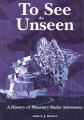
To See the Unseen: A History of Planetary Radar Astronomy
by Andrew J. Butrica
Publisher: NASA History Division 1996
ISBN/ASIN: 0160485789
ISBN-13: 9780160485787
Number of pages: 301
Description:
Andrew J. Butrica has written a comprehensive and illuminating history of this little-understood but surprisingly significant scientific discipline. Quite rigorous and systematic in its methodology, To See the Unseen explores the development of the radar astronomy specialty in the larger community of scientists.
Download or read it online for free here:
Read online
(online html)
Similar books
 Traces of Catastrophe
by Bevan M French - Lunar and Planetary Institute
A detailed introduction to impact processes, crater formation, and shock metamorphism. The book is intended for geoscientists of all kinds: students, professors and professional geologists who may encounter an impact structure in the field area.
(13308 views)
 Atomic and Molecular Processes in Astronomy and Planetary Science
by Geoffrey A. Blake - California Institute of Technology
This course discusses the fundamental aspects of atomic and molecular spectra that enable one to infer physical conditions in astronomical, planetary and terrestrial environments from the analysis of their electromagnetic radiation.
(13694 views)
 Consolidated Lunar Atlas
by Gerald P. Kuiper, et al. - Lunar and Planetary Institute
In the dawn of the Space Age, NASA undertook to find and assemble the very best images of the Moon it could find. In a project led by Gerard Kuiper, the best telescopic plates from observatories around the world were assembled into one compilation.
(11555 views)
 Mercury
by F. Vilas, C. Chapman, M. Matthews - University of Arizona Press
The book on the planet's origin, its metal-rich composition, its thermal and geophysical evolution, and its cratering history. These topics are complex and controversial, and this book contains a variety of new perspectives on them.
(14199 views)