
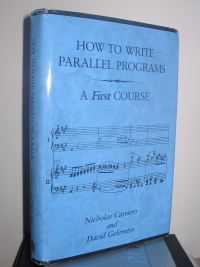
How to Write Parallel Programs: A First Course
by Nicholas Carriero, David Gelernter
Publisher: MIT Press 1992
ISBN/ASIN: 026203171X
ISBN-13: 9780262031714
Number of pages: 246
Description:
In the not-too-distant future every programmer, software engineer, and computer scientist will need to understand parallelism, a powerful and proven way to run programs fast. The authors of this straightforward tutorial explain why this is so and provide the instruction that will transform ordinary programmers into parallel programmers.
Download or read it online for free here:
Download link
(1.1MB, PDF)
Similar books
 Concurrent Programming in Erlang
by Robert Virding, Claes Wikstrom, Mike Williams - Prentice Hall PTR
A tutorial of Erlang, a concurrent, functional programming language. The emphasis of this book is on learning through example and a number of well known problems in designing and programming concurrent fault-tolerant real-time systems.
(19323 views)
 Petri Nets: Manufacturing and Computer Science
by Pawel Pawlewski (ed.) - InTech
The present monograph focuses on Petri Nets applications in two main areas: manufacturing and computer science. The theory of Petri Nets is still developing: some directions of investigations are presented in this volume.
(9272 views)
 Parallel Complexity Theory
by Ian Parberry - Prentice Hall
The rapid growth of parallel complexity theory has led to a proliferation of parallel machine models. This book presents a unified theory of parallel computation based on a network model. It is the first such synthesis in book form.
(9437 views)
 Programming on Parallel Machines
by Norm Matlo ff - University of California, Davis
This book is aimed more on the practical end of things, real code is featured throughout. The emphasis is on clarity of the techniques and languages used. It is assumed that the student is reasonably adept in programming and linear algebra.
(8763 views)