
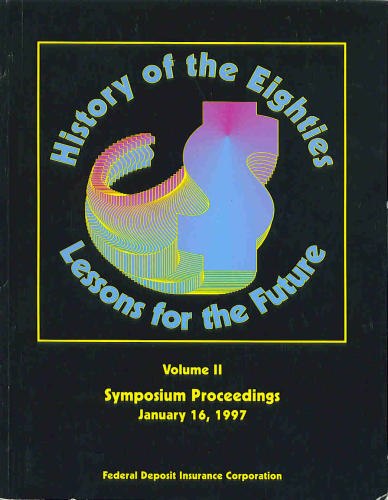
History of the Eighties -- Lessons for the Future
Publisher: Federal Deposit Insurance Corporation 1997
ISBN/ASIN: 0966180801
Number of pages: 267
Description:
A detailed analysis of the complex combination of causes (economic, financial, legislative and regulatory) that led to the extraordinary number of bank failures in the 1980s and early 1990s. An evaluation of the legislative, regulatory and supervisory responses to those failures. An assessment of the implications the experiences of the 1980s and early 1990s hold for deposit insurance and bank supervision in the future.
Download or read it online for free here:
Download link
(multiple PDF files)
Similar books
 Money and Banking
by Robert E. Wright, Vincenzo Quadrini - Saylor Foundation
Minimal mathematics, accessible language, and a student-oriented tone ease readers into complex subjects like money, interest rates, banking, asymmetric information, financial crises and regulation, monetary policy, monetary theory, and other topics.
(35805 views)
 Banking Regulation
by Kenneth Spong - Federal Reserve Bank of Kansas City
This book covers many different aspects of banking regulation: the basic purposes of banking regulation in the United States, the historical development of our regulatory system, the basic powers of banks and bank holding companies, and more.
(15238 views)
 Central Banking and Monetary Policy: An Introduction
by AP Faure - Bookboon
This book presents an introduction to central banking and monetary policy. Central banking is not just about monetary policy. It is also about being banker and advisor to government and managing the money and banking system ...
(11388 views)
 The Case Against the Fed
by Murray N. Rothbard - Ludwig Von Mises Institute
The author presents the most powerful case against the American central bank ever written. This work begins with a mini-treatment of money and banking theory, and then plunges right in with the real history of the Federal Reserve System.
(16280 views)