
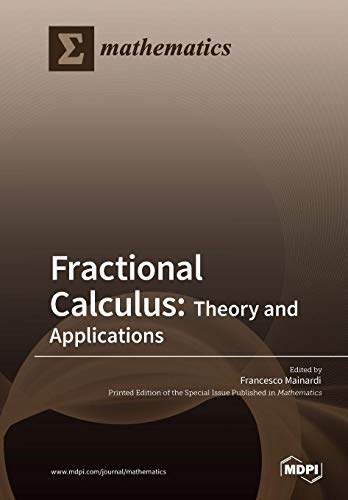
Fractional Calculus: Theory and Applications
by Francesco Mainardi (ed.)
Publisher: MDPI AG 2018
ISBN-13: 9783038972068
Number of pages: 210
Description:
Fractional calculus is allowing integrals and derivatives of any positive order (the term fractional is kept only for historical reasons). It can be considered a branch of mathematical physics that deals with integro-differential equations, where integrals are of convolution type and exhibit mainly singular kernels of power law or logarithm type.
Download or read it online for free here:
Download link
(4.3MB, PDF)
Similar books
 Special Fuzzy Matrices for Social Scientists
by W. B. V. Kandasamy, F. Smarandache, K. Ilanthenral - InfoLearnQuest
This book introduces special classes of Fuzzy and Neutrosophic Matrices. These special classes of matrices are used in the construction of multi-expert special fuzzy models using FCM, FRM and FRE and their Neutrosophic analogues.
(12978 views)
 Handbook of Mathematics for Engineers
by E. V. Huntington, L. A. Fischer - McGraw Hill
The Handbook contains, in compact form, accurate statements of those facts and formulas of mathematics which are likely to be useful to the worker in applied mathematics. It is thought to be more comprehensive than any other similar work in English.
(26819 views)
 Cook-Book Of Mathematics
by Viatcheslav Vinogradov - CERGE-EI
Simple recipes for solving problems students might face in their studies of economics. The main goal was to refresh students' knowledge of mathematics rather than teach them math from scratch, BA level mathematics is required.
(25232 views)
 Symmetry Measures on Complex Networks
by Angel Garrido (ed.) - MDPI AG
Symmetry and Complex Networks are essential in many sciences. That is why these two themes have been unified here, whose intersection we are dealing with: in its first part, of fundamentals, and in its second part of applications, which are multiple.
(5944 views)