
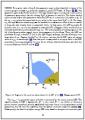
Introduction to Supersymmetry: Astrophysical and Phenomenological Constraints
by Keith A. Olive
Publisher: arXiv 1999
Number of pages: 67
Description:
These lectures on supersymmetry contain a pedagogical description of supersymmetric theories and the minimal supersymmetric standard model. Phenomenological and cosmological consequences of supersymmetry are also discussed.
Download or read it online for free here:
Download link
(730KB, PDF)
Similar books
 Special Functions: Fractional Calculus and the Pathway for Entropy
by Hans J. Haubold (ed.) - MDPI AG
The notion of entropy emerged in conceptually very distinct contexts. This book deals with the connection between entropy, probability, and fractional dynamics as they appeared, for example, in solar neutrino astrophysics since the 1970's.
(6984 views)
 Cosmology and Astrophysics
by Juan Garcia-Bellido - arXiv.org
In these lectures I review the present status of the so-called Standard Cosmological Model, based on the hot Big Bang Theory and the Inflationary Paradigm. I will make special emphasis on the recent developments in observational cosmology ...
(8799 views)
 Mathematical Problems Of Radiative Equilibrium
by Eberhard Hopf - Cambridge University Press
Schwarzschild's work on absorption and diffusion in the sun's atmosphere rendered the theory of radiative equilibrium a definite chapter of mathematical astrophysics. Besides the known results the reader will also find discussions of other models.
(6409 views)
 High Performance Computing and Numerical Modelling
by Volker Springel - arXiv
These are lecture notes about high performance computing and numerical modelling in 43rd Saas Fee Advanced Course winter school, specifically covering the basics of numerically treating gravity and hydrodynamics in the context of galaxy evolution.
(10832 views)