
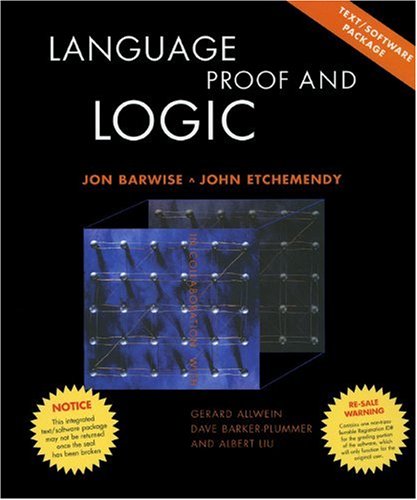
Language, Proof and Logic
by Jon Barwise, John Etchemendy
Publisher: Center for the Study of Language 2011
ISBN/ASIN: 157586374X
ISBN-13: 9781575863740
Number of pages: 620
Description:
This textbook/software package covers first-order language in a method appropriate for first and second courses in logic. The unique on-line grading services instantly grades solutions to hundred of computer exercises. It is specially devised to be used by philosophy instructors in a way that is useful to undergraduates of philosophy, computer science, mathematics, and linguistics. Advanced chapters include proofs of soundness and completeness for propositional and predicate logic, as well as an accessible sketch of Godel's first incompleteness theorem.
Download or read it online for free here:
Download link
(2.5MB, PDF)
Similar books
 Prolog and Natural-Language Analysis
by F. C. N. Pereira, S. M. Shieber - Center for the Study of Language
A concise introduction to logic programming and the logic-programming language Prolog both as vehicles for understanding elementary computational linguistics and as tools for implementing the basic components of natural-language-processing systems.
(21244 views)
 Natural Language Processing for Prolog Programmers
by Michael A. Covington - Prentice-Hall
Designed to bridge the gap for those who know Prolog but have no background in linguistics, this book concentrates on turning theories into practical techniques. Coverage includes template and keyword systems, definite clause grammars, and more.
(11089 views)
 Stochastic Attribute-Value Grammars
by Rob Malouf, Miles Osborne - ESSLLI
This text provides an introduction to the maximum entropy principle and the construction of maximum entropy models for natural language processing. We investigate the implementation of maximum entropy models for attribute-value grammars.
(9262 views)
 Speech and Language Processing
by Dan Jurafsky, James H. Martin - Stanford University
This text takes an empirical approach to the subject, based on applying statistical and machine-learning algorithms to large corporations. The authors describe a unified vision of speech and language processing. Emphasis is on practical applications.
(7345 views)